Succeeding with OKRs in Agile
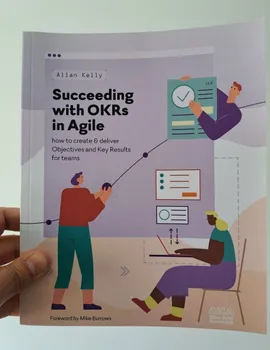
Succeeding with OKRs in Agile: How to create & deliver objectives & key results for teams by Allan Kelly is a well‑known, practical guide for applying OKRs inside Agile environments. It’s widely praised for being experience‑based rather than theoretical, and for showing how OKRs actually work “day‑by‑day, sprint‑by‑sprint, quarter‑by‑quarter.”
What the book is about
Section titled “What the book is about”1. Why OKRs matter for Agile teams
Section titled “1. Why OKRs matter for Agile teams”OKRs focus on big, strategic goals rather than backlog items. They help teams:
- Align around purpose and strategy
- Think beyond the next story or epic
- Engage senior leaders
- Debug unclear product strategy
This makes OKRs a natural complement to Agile, since both are outcome‑oriented and results‑focused.
- Outcome orientation
- Agile strategy alignment
2. How to write effective OKRs
Section titled “2. How to write effective OKRs”Kelly emphasizes:
- Objectives = big goals
- Key Results = measurable tests that prove the objective is achieved
He frames OKRs as “Test‑Driven Management”:
- Decide the objective
- Define acceptance criteria (KRs)
- Execute until the tests pass
- Test‑driven management
3. How to deliver OKRs in practice
Section titled “3. How to deliver OKRs in practice”The book is highly pragmatic and covers:
- How teams execute OKRs within sprints
- How to inspect and adapt OKRs each quarter
- How OKRs expose organizational problems
- How OKRs help communicate with senior managers
- Quarterly OKR cycles
Kelly also warns against top‑down MBO‑style OKRs, which reintroduce command‑and‑control and undermine Agile.
- Top‑down OKR pitfalls
4. Patterns, anti‑patterns, and pitfalls
Section titled “4. Patterns, anti‑patterns, and pitfalls”The book includes entire chapters on:
- Going off‑piste
- Everyday pitfalls
- Trouble with targets
- OKR anti‑patterns
It acknowledges the messiness of real‑world product development.
5. Who the book is for
Section titled “5. Who the book is for”It’s especially useful for:
- Agile coaches
- Product owners
- Engineering managers
- Teams adopting OKRs for the first time
- Medium‑sized companies where OKRs must coexist with Agile delivery
- Agile roles
Core takeaway
Section titled “Core takeaway”The book teaches that OKRs are a mechanism for agreeing shared goals, communicating them clearly, and driving action, and that they work best when teams co‑create them rather than receiving them top‑down.