Good Strategy / Bad Strategy
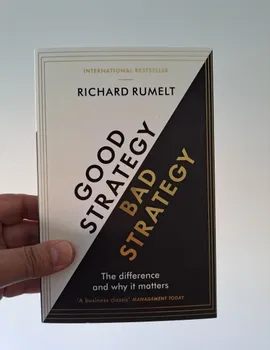
Good Strategy / Bad Strategy by Richard Rumelt is one of the most influential modern books on strategic thinking. The core takeaway is that good strategy is built on clear diagnosis, a guiding policy, and coherent actions, while bad strategy is fluff, slogans, and wishful thinking.
What the book is about
Section titled “What the book is about”The book’s central claim is that most organizations don’t actually have a strategy — they have goals, visions, or buzzwords. Real strategy requires focus, choice, and a logical chain from problem → approach → action.
Core concepts
Section titled “Core concepts”1. The Kernel — the structure of any good strategy
Section titled “1. The Kernel — the structure of any good strategy”Rumelt defines a “kernel” with three parts:
- Diagnosis — identifying the critical challenge.
- Guiding policy — the general approach to overcome it.
- Coherent actions — coordinated steps that implement the policy.
This triad is the book’s most famous contribution.
2. Bad Strategy — what goes wrong
Section titled “2. Bad Strategy — what goes wrong”Rumelt highlights four hallmarks of bad strategy:
- Fluff (empty, high‑sounding language)
- Failure to face the real challenge
- Mistaking goals for strategy
- Bad strategic objectives (unfocused, contradictory, or impossible)
3. Sources of Power
Section titled “3. Sources of Power”Good strategy creates leverage by:
- Focusing on the most critical issues
- Exploiting asymmetries
- Understanding systems and bottlenecks
- Using design thinking to align actions
Examples Rumelt uses
Section titled “Examples Rumelt uses”- Steve Jobs at Apple (1997) — radical simplification of the product line.
- IBM under Lou Gerstner — diagnosing fragmentation and shifting to integrated solutions.
- Lehman Brothers (bad strategy) — increasing risk without mitigation.
These cases illustrate how good strategy focuses and bad strategy avoids hard choices.
Why it matters
Section titled “Why it matters”It’s widely used in business strategy, product strategy, leadership, and organizational transformation because it gives a practical, testable framework. You can evaluate any plan by asking:
- What’s the diagnosis?
- What’s the guiding policy?
- What coherent actions follow?
If any are missing, you don’t have a strategy — you have a slogan.