The Automated Enterprise
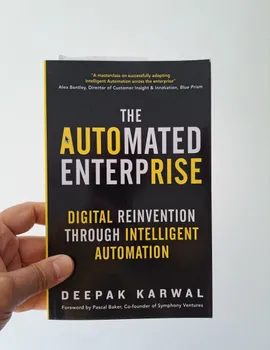
The Automated Enterprise: Digital Reinvention Through Intelligent Automation by Deepak Karwal is a business and technology book focused on how organisations can use Intelligent Automation (IA) as a strategic capability rather than a collection of isolated automation projects. Published in 2020, it targets leaders, transformation professionals, and automation practitioners.
What the book is about
Section titled “What the book is about”The book explores how organisations can build and scale intelligent automation capabilities across the enterprise. According to the book description, it helps readers:
- Understand why automation has become so impactful
- Appreciate the “multiplier effect” of intelligent automation
- Use automation as an enabler of digital transformation
- Develop a practical approach for embedding automation capabilities within the organisation
Key themes throughout the book
Section titled “Key themes throughout the book”1. The evolution from RPA to Intelligent Automation
Section titled “1. The evolution from RPA to Intelligent Automation”Karwal explains that traditional automation focused on repetitive tasks. Intelligent Automation expands this by combining technologies such as:
- Robotic Process Automation (RPA)
- Artificial Intelligence
- Machine Learning
- Process Intelligence
- Analytics
The combination creates greater business value than any single technology alone.
2. Digital reinvention of the enterprise
Section titled “2. Digital reinvention of the enterprise”The author treats automation not as an IT initiative but as a business transformation capability.
The goal is to redesign how work is performed, how employees interact with technology, and how customers experience services.
3. Building automation as a capability
Section titled “3. Building automation as a capability”A major focus is governance and operating models:
- Automation Centres of Excellence (CoEs)
- Delivery models
- Automation strategy
- Scaling mechanisms
- Talent and skills development
This is particularly relevant for organisations trying to move beyond a handful of successful pilots.
4. Human and organisational change
Section titled “4. Human and organisational change”Karwal also discusses the human side of automation:
- Employee adoption
- Change management
- Leadership alignment
- New roles and responsibilities
The book emphasises that technology succeeds only when people and processes evolve with it.
Core takeaway
Section titled “Core takeaway”The book’s central message is:
Successful digital transformation is not achieved by technology alone. It happens when organisations systematically embed intelligent automation into their operating model, culture, processes, and decision-making.
Karwal argues that many companies view automation as a cost-reduction exercise. The real opportunity is much larger: creating an enterprise that continuously reinvents itself through automation, AI, analytics, and process optimisation. Intelligent automation becomes a multiplier that improves productivity, customer experience, employee experience, and business agility simultaneously.
In practical terms, automation should evolve from:
- Automating individual tasks
- To automating end-to-end processes
- To enabling enterprise-wide transformation
- To creating a continuously improving digital organisation
Why it matters
Section titled “Why it matters”1. It moves beyond the “automation saves costs” narrative
Section titled “1. It moves beyond the “automation saves costs” narrative”Many automation books focus primarily on eliminating manual effort.
Karwal broadens the conversation to:
- Business agility
- Innovation
- Customer value
- Organisational resilience
- Competitive advantage
This is a more modern view of automation that aligns with today’s AI-driven businesses.
2. It addresses the enterprise scaling challenge
Section titled “2. It addresses the enterprise scaling challenge”Many organisations can automate a few processes.
Far fewer can scale automation across business units, functions, and geographies.
One of the book’s strengths is its focus on the organisational structures and governance needed to scale successfully.
3. It connects automation to digital transformation
Section titled “3. It connects automation to digital transformation”The book treats automation as a foundational component of digital transformation rather than a separate initiative.
This perspective remains highly relevant today, particularly with the rise of:
- AI agents
- Generative AI
- Hyperautomation
- Intelligent workflows
- Autonomous operations
4. It is practical rather than purely theoretical
Section titled “4. It is practical rather than purely theoretical”The book is aimed at practitioners and leaders looking to build automation programmes, not researchers studying automation academically.
In summary:
The most valuable lesson for today’s AI era is:
Automation maturity is less about deploying more bots or AI models and more about creating an operating model where humans, AI, workflows, and business processes continuously improve each other.
That idea has arguably become even more important with Agentic AI than it was when the book was published.
The Automated Enterprise is a playbook for turning automation from a tactical efficiency tool into a strategic capability for enterprise-wide digital reinvention.