Lean Software Development
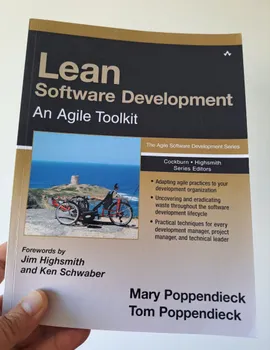
Lean Software Development: An Agile Toolkit by Mary Poppendieck and Tom Poppendieck is a foundational book in both Lean and Agile circles. It was first published in 2003 and remains one of the most influential texts for translating Lean manufacturing principles into software development.
What the book is about
Section titled “What the book is about”The book adapts Lean principles from the Toyota Production System into seven software‑specific principles:
- Eliminate Waste — remove anything that doesn’t add customer value.
- Amplify Learning — treat development as continuous discovery.
- Decide as Late as Possible — keep options open to manage uncertainty.
- Deliver as Fast as Possible — shorten cycle times and feedback loops.
- Empower the Team — decentralize decision‑making.
- Build Integrity In — ensure coherence, maintainability, and usability.
- See the Whole — optimize the entire value stream, not isolated parts.
These principles are expanded through 22 “thinking tools”, which are practical techniques for managers, tech leads, and teams.
Core takeaway
Section titled “Core takeaway”Lean Software Development = eliminate waste, amplify learning, deliver fast, empower people, build integrity, and see the whole.
Why it matters
Section titled “Why it matters”- It was one of the first works to bridge Lean and Agile, influencing Kanban, DevOps, and modern flow‑based delivery.
- It emphasizes value stream thinking, which is now central to Agile scaling frameworks.
- It provides practical guidance, not just theory — making it useful for engineering managers and hands‑on teams.
- Many modern practices (small batches, WIP limits, fast feedback, empowered teams) trace back to this book.