The Future Is Faster Than You Think
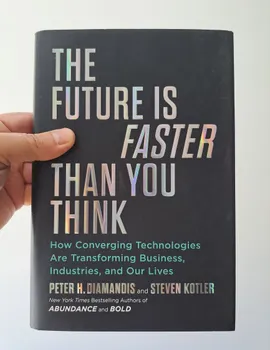
The Future Is Faster Than You Think by Peter H. Diamandis and Steven Kotler.
What the book is about
Section titled “What the book is about”Convergence as the central thesis
Section titled “Convergence as the central thesis”Diamandis and Kotler emphasize that technologies no longer evolve in isolation. When AI meets robotics, or sensors meet networks, or VR meets AI, the result is multiplicative breakthroughs, not additive ones. This is the engine of the next decade’s disruption.
Exponential progress
Section titled “Exponential progress”They build on Kurzweil’s Law of Accelerating Returns: anything digital doubles in power and halves in cost on predictable cycles. Humans think linearly, so exponential curves feel “flat” until they suddenly become overwhelming.
The Six Ds framework
Section titled “The Six Ds framework”The book uses the Six Ds of Exponential Technologies — Digitized, Deceptive, Disruptive, Demonetized, Dematerialized, Democratized — to explain how industries transform once their core processes become information.
How industries will change
Section titled “How industries will change”Transportation
Section titled “Transportation”Autonomous vehicles, drones, aerial taxis, and hyperloop systems will reshape mobility, reduce costs, eliminate parking needs, and shift ownership toward Mobility‑as‑a‑Service.
Retail & advertising
Section titled “Retail & advertising”AI, AR, VR, sensors, and real‑time data will create hyper‑personalized shopping experiences. Retailers that fail to adopt these technologies will be outcompeted.
Education
Section titled “Education”VR/AR + AI tutors will enable immersive, personalized learning accessible globally — e.g., students attending virtual MIT lectures or experiencing historical events in VR.
Healthcare
Section titled “Healthcare”Gene editing (CRISPR), AI diagnostics, sensors, and robotics will shift healthcare from reactive treatment to continuous, personalized prevention.
Everyday life
Section titled “Everyday life”Expect:
- 3D‑printed goods on demand
- Autonomous delivery robots
- VR/AR integrated into work and leisure
- Lab‑grown food
Core takeaway
Section titled “Core takeaway”The book argues that converging exponential technologies — AI, robotics, VR/AR, sensors, networks, biotech, quantum computing — are accelerating simultaneously and reinforcing one another, creating non‑linear, explosive change across every major industry.
Why it matters
Section titled “Why it matters”Diamandis and Kotler argue that the next decade will bring more upheaval and wealth creation than the previous century, driven by accelerators like global connectivity, abundant venture capital, and longer lifespans. Businesses and individuals must understand these shifts to remain relevant.
Key insights
Section titled “Key insights”- Convergence is the real disruptor.
- Exponential curves look slow until they suddenly dominate.
- Abundance emerges when costs collapse toward zero.
- Every industry should ask: What part of our business becomes information first?