User Story Mapping
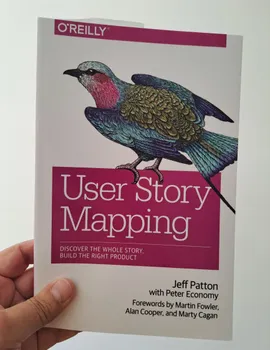
User Story Mapping: Discover the Whole Story, Build the Right Product by Jeff Patton and Peter Economy is one of the most influential books in modern Agile product development. It explains why user stories often fail in practice and how story mapping creates shared understanding, reveals gaps, and aligns teams around outcomes rather than output.
What the book is about
Section titled “What the book is about”1. User stories as “tokens for conversation”
Section titled “1. User stories as “tokens for conversation””Patton emphasizes that user stories are not requirements documents — they are prompts for discussion. Written specs alone fail to create shared understanding.
This is the foundation of story mapping: stories must be talked through, arranged, challenged, and refined collaboratively.
2. The problem with flat backlogs
Section titled “2. The problem with flat backlogs”A traditional backlog hides the big picture. Teams lose context, miss dependencies, and focus on isolated features. Story maps fix this by laying out the user’s journey left‑to‑right, exposing gaps and opportunities.
3. The story map structure
Section titled “3. The story map structure”A story map has three layers:
- Backbone — high‑level user activities
- Steps — the narrative flow of how users accomplish tasks
- Details — specific behaviors, variations, and edge cases
This structure helps teams think “mile wide, inch deep” before diving into detail.
4. Slicing for releases, learning, and delivery
Section titled “4. Slicing for releases, learning, and delivery”Patton shows how to slice the map into:
- Release strategies — smallest meaningful product increments
- Learning strategies — experiments to validate assumptions
- Development strategies — build order based on risk and value
This is where story mapping becomes a strategic tool, not just a visualization.
5. Discovery, validated learning, and continuous iteration
Section titled “5. Discovery, validated learning, and continuous iteration”The book integrates Agile, Lean, and UX thinking:
- Continuous discovery
- Cross‑functional collaboration
- Iterative delivery
- Watching real user behavior to refine the product
Core takeaway
Section titled “Core takeaway”The book teaches teams to visualize the product as a narrative of user activities, then slice it into meaningful releases that deliver outcomes — not just features.
Why it matters
Section titled “Why it matters”For product managers, UX designers, engineers, and Agile coaches, the book provides a practical method to:
- Build shared understanding
- Avoid feature‑factory output
- Align teams around outcomes
- Reveal gaps and edge cases early
- Plan meaningful MVPs and iterative releases