Team of Teams
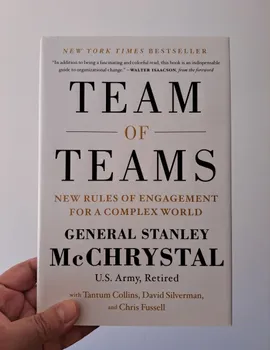
Team of Teams is one of the most influential modern leadership books. The core idea is that traditional hierarchical organizations break down in complex, fast‑moving environments, and the only way to stay effective is to operate as a network of small, empowered, highly connected teams.
Core takeaway
Section titled “Core takeaway”A team of teams succeeds by combining shared consciousness (radical information transparency) with empowered execution (decentralized decision‑making). This lets large organizations act with the speed and adaptability of a small special‑operations unit.
Key concepts
Section titled “Key concepts”1. Shared consciousness
Section titled “1. Shared consciousness”Everyone sees the whole picture, not just their silo. McChrystal’s Task Force replaced “need‑to‑know” with need‑to-share, using daily cross‑team intelligence briefings to synchronize thousands of people.
This transparency builds trust and dramatically increases speed.
2. Empowered execution
Section titled “2. Empowered execution”Decisions move to the people closest to the problem. Leaders stop micromanaging and instead set intent, allowing operators to act without waiting for permission.
This shift was essential to outmaneuver AQI’s decentralized network.
3. Complexity vs. complication
Section titled “3. Complexity vs. complication”McChrystal distinguishes predictable, mechanical systems (“complicated”) from unpredictable, interconnected ones (“complex”).
Modern organizations operate in complexity — meaning efficiency alone becomes a liability.
4. The failure of Taylorism
Section titled “4. The failure of Taylorism”Frederick Taylor’s scientific management optimized factories but created brittle hierarchies.
In Iraq, the Task Force was extremely efficient — yet too slow for a networked adversary that constantly recomposed itself.
5. Resilience over efficiency
Section titled “5. Resilience over efficiency”Optimizing for efficiency works in stable environments.
But in complex systems, resilience — the ability to adapt quickly — is far more important.
AQI’s fluid structure forced the Task Force to become equally adaptive.
Why it matters
Section titled “Why it matters”The book’s lessons map directly to modern engineering, product, and organizational challenges:
- Siloed teams slow down decision‑making.
- Transparency accelerates alignment.
- Distributed authority enables speed.
- Leaders must act as gardeners, shaping culture and information flow rather than directing every move.
This is especially relevant to Agile, Scrum, DevOps, and enterprise transformation literature all converge on the same principle: adaptability beats control.