Measure What Matters
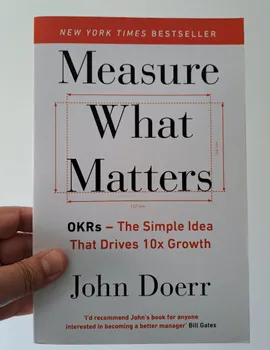
Measure What Matters by John Doerr is a well‑known management book that popularized the OKR (Objectives and Key Results) framework. At its core, the book argues that organizations achieve extraordinary outcomes when they set clear objectives and measurable key results, making execution disciplined, transparent, and aligned across teams.
What the book is about
Section titled “What the book is about”The central idea is that ideas are easy; execution is everything. OKRs provide a simple but powerful structure:
- Objectives — what you want to achieve (significant, concrete, inspirational).
- Key Results — how you measure success (specific, time‑bound, and always numerical).
Doerr illustrates this through case studies from Intel, Google, The Gates Foundation, Bono’s ONE Campaign, and others, showing how OKRs create:
- Focus & commitment
- Alignment & connection across teams
- Tracking for accountability
- Stretch goals that push organizations beyond comfort
Core insights
Section titled “Core insights”- A key result must have a number, or it isn’t a key result.
- OKRs should be public, brief, and separate from compensation to avoid sandbagging.
- Organizations should use 3–5 objectives per cycle to maintain focus.
- Goals should evolve — update, continue, or stop them as conditions change.
- Pair goals with counter‑measures to avoid tunnel vision (e.g., quantity vs. quality).
Why it matters
Section titled “Why it matters”Doerr helped introduce OKRs to Google in 1999, when the company had great technology but no structured way to prioritize. OKRs became part of Google’s operating system as it scaled from a small startup to tens of thousands of employees.