The Wisdom of Crowds
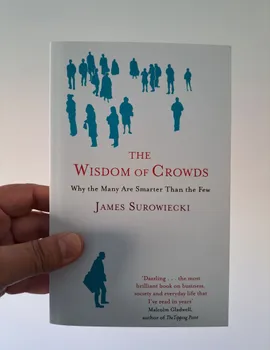
The Wisdom of Crowds by James Surowiecki is a well‑known 2004 nonfiction book arguing that large, diverse, independent groups often make better decisions than individual experts.
It explores how collective intelligence emerges when certain conditions are met, using case studies from economics, psychology, history, and real-world problem‑solving. The book became a New York Times bestseller and remains influential in discussions about decision‑making, forecasting, markets, and organizational behavior.
What the book is about
Section titled “What the book is about”- Cognition — crowds can make surprisingly accurate predictions (e.g., the famous ox‑weight guessing experiment).
- Coordination — groups self‑organize efficiently without central control (traffic flow, bar attendance patterns).
- Cooperation — decentralized networks can build trust and solve problems without hierarchy.
- Diversity & independence — essential to avoid groupthink and amplify collective intelligence.
Core takeaway
Section titled “Core takeaway”A group can outperform even its smartest members when:
- individuals think independently,
- the group is diverse,
- knowledge is distributed,
- and there is a mechanism to aggregate judgments effectively.
Surowiecki contrasts “wise crowds” with irrational ones (e.g., bubbles, mobs), showing that structure and independence matter.
Why it matters
Section titled “Why it matters”It challenges the “cult of the expert” and shows how properly structured groups outperform top‑down decision systems in business, politics, markets, and crisis situations.
Surowiecki’s examples include:
- predicting the location of the lost submarine Scorpion,
- market behavior and economic forecasting,
- jury deliberations,
- crowdsourcing puzzles and complex problems.