Getting to Yes
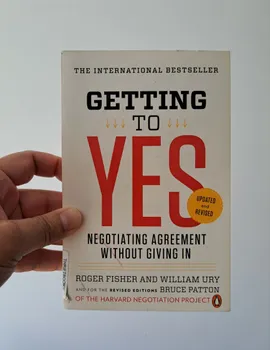
Getting to Yes: Negotiating Agreement Without Giving In by Roger Fisher, William Ury, and later Bruce Patton is one of the most influential books ever written on negotiation. Published under the Harvard Negotiation Project, it introduced what is known as Principled Negotiation, a method that focuses on reaching wise agreements without damaging relationships.
What the book is about
Section titled “What the book is about”The book teaches a structured framework called Principled Negotiation, built on four key principles.
Principle 1: Separate the People from the Problem
Section titled “Principle 1: Separate the People from the Problem”People often mix emotion, ego, and relationships into negotiations.
The authors recommend:
- Attack the problem, not the person.
- Listen actively.
- Show understanding.
- Manage emotions before discussing solutions.
Example
Section titled “Example”Instead of:
“You’re being unreasonable.”
Say:
“Let’s understand what constraints we’re both working with.”
This reduces defensiveness and keeps discussions productive.
Principle 2: Focus on Interests, Not Positions
Section titled “Principle 2: Focus on Interests, Not Positions”Positions are the demands people make.
Interests are the reasons behind those demands.
Classic Example
Section titled “Classic Example”Two people both want the same orange.
Positional bargaining:
- Split it in half.
Interest-based bargaining:
- One wants the juice.
- One wants the peel for baking.
Result:
- Each gets 100% of what they actually need.
The lesson:
Interests create opportunities for mutual gain.
Principle 3: Invent Options for Mutual Gain
Section titled “Principle 3: Invent Options for Mutual Gain”Before deciding on an agreement, generate multiple possibilities.
Most negotiations fail because people prematurely lock onto a single solution.
The authors recommend brainstorming:
- Without judging ideas too early
- Looking for win-win opportunities
- Expanding the pie before dividing it
Questions to ask:
- What would satisfy both sides?
- What alternatives haven’t been considered?
- How can we create value together?
Principle 4: Insist on Objective Criteria
Section titled “Principle 4: Insist on Objective Criteria”When negotiations become personal, disagreements often turn into power struggles.
Instead, use:
- Market value
- Industry benchmarks
- Expert opinion
- Legal standards
- Performance metrics
Example
Section titled “Example”Rather than arguing:
“I deserve a higher salary.”
Use:
“According to current market compensation data, similar roles in this region pay between €X and €Y.”
Objective standards reduce conflict and improve fairness.
BATNA: The Most Important Concept in the Book
Section titled “BATNA: The Most Important Concept in the Book”Many readers consider BATNA the book’s most valuable idea.
BATNA stands for:
Best Alternative To a Negotiated Agreement
Your BATNA is what you’ll do if the negotiation fails.
Example
Section titled “Example”Suppose you’re negotiating a job offer.
Offer:
- €70,000 salary
Alternative:
- Another company has already offered €75,000.
Your BATNA is strong.
You can negotiate confidently because you’re not dependent on this single deal.
By contrast, if you have no alternatives, your bargaining power is weaker.
Key Insight
Section titled “Key Insight”You should never compare an offer against your wishes.
Instead compare it against your BATNA.
Ask:
Is this agreement better than my next-best option?
If not, walk away.
Core takeaway
Section titled “Core takeaway”The central message is:
Don’t negotiate based on positions. Negotiate based on interests.
Most people negotiate by taking positions:
- “I want €100,000.”
- “I will only pay €70,000.”
This creates a battle of wills where one side wins and the other loses.
Instead, the authors argue that successful negotiators look beneath positions and identify the underlying interests driving them.
Example
Section titled “Example”Position:
- Employee: “I want to work from home three days a week.”
- Manager: “Everyone must be in the office.”
Interests:
- Employee: Better focus, less commuting, work-life balance.
- Manager: Team collaboration, visibility, accountability.
Once interests are understood, new solutions emerge:
- Hybrid schedules
- Core collaboration days
- Measured performance goals
The discussion shifts from confrontation to problem-solving.
Why it matters
Section titled “Why it matters”It Changed How Negotiation Is Taught
Section titled “It Changed How Negotiation Is Taught”Before Getting to Yes, many negotiation approaches focused on:
- Pressure
- Power
- Winning
- Concessions
The book shifted the conversation toward:
- Collaboration
- Problem-solving
- Shared interests
- Long-term relationships
Today its concepts are taught in:
- Business schools
- MBA programmes
- Law schools
- Diplomacy and conflict resolution programmes
- Corporate leadership training
It Applies Everywhere
Section titled “It Applies Everywhere”Many people assume negotiation only happens in business deals.
The book shows negotiation is part of everyday life:
- Salary discussions
- Project prioritisation
- Vendor contracts
- Family decisions
- Team conflicts
- Customer relationships
- Workplace resource allocation
These ideas especially useful for:
- Negotiating project scope
- Managing conflicting stakeholder priorities
- Discussing budgets and timelines
- Resolving team disagreements
- Aligning product and engineering goals
It Balances Results and Relationships
Section titled “It Balances Results and Relationships”One of the biggest strengths of the book is that it rejects the false choice between:
- Being tough and getting results
- Being nice and preserving relationships
The authors argue you can do both.
The ideal outcome is:
A wise agreement reached efficiently that improves or at least preserves the relationship.
Key Concepts
Section titled “Key Concepts”| Concept | Meaning |
|---|---|
| Separate people from the problem | Deal with issues without attacking individuals |
| Focus on interests, not positions | Understand the “why” behind demands |
| Invent options for mutual gain | Create win-win possibilities |
| Use objective criteria | Base decisions on fair standards |
| BATNA | Know your best alternative if no agreement is reached |
| Principled Negotiation | Collaborative, interest-based negotiation method |
Final Thought
Section titled “Final Thought”The enduring lesson of Getting to Yes is that the best negotiators are not the most aggressive or persuasive. They are the ones who can understand interests, create value, and use objective standards to reach agreements that both sides view as fair. The book teaches negotiation as a joint problem-solving exercise, rather than a contest of wills, which is why it remains a classic decades after its publication.