Practical Process Automation
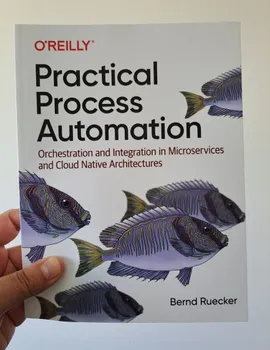
Practical Process Automation by Bernd Rücker is one of the most important modern books on workflow engines, orchestration, and developer‑friendly process automation in microservice and cloud‑native architectures.
What the book is about
Section titled “What the book is about”1. Fundamentals of modern process automation
Section titled “1. Fundamentals of modern process automation”- Why microservices and serverless architectures make processes harder (distributed, asynchronous, long‑running).
- Why state handling must be externalized (workflow engines instead of stateful services).
- How BPMN and DMN provide executable, testable, versionable models.
2. Workflow engines as first‑class components
Section titled “2. Workflow engines as first‑class components”- Core workflow engine capabilities: persistence, retries, timers, message correlation, compensation.
- Architecture patterns: centralized vs. decentralized engines, shared vs. embedded models.
- How workflow engines compare to SOA, batch jobs, event streaming, actor models, and data pipelines.
3. Orchestration vs. choreography
Section titled “3. Orchestration vs. choreography”One of the strongest contributions of the book is its clear explanation of when to orchestrate and when to choreograph — and how to balance both.
- Orchestration = explicit control flow, visibility, monitoring, resilience.
- Choreography = decentralized event‑driven interactions.
- Most real systems need both, but orchestration provides clarity for long‑running, business‑critical flows.
4. Modeling and implementing processes
Section titled “4. Modeling and implementing processes”- BPMN elements: events, gateways, tasks, message flows, compensation.
- Combining BPMN with code (connectors, workers, microservices).
- Testing, versioning, running multiple process versions in parallel.
5. Orchestrating everything
Section titled “5. Orchestrating everything”The book shows how workflow engines can orchestrate:
- Software (microservices, serverless functions)
- Decisions (DMN)
- Humans (task lists, UIs)
- RPA bots
- Physical devices (IoT)
This breadth is one reason the book is popular among architects.
6. Enterprise adoption
Section titled “6. Enterprise adoption”- Architecture guidelines for introducing workflow engines.
- Typical misconceptions (“BPMN is heavy”, “workflow engines don’t scale”).
- How to start with grassroots initiatives → lighthouse projects → center of excellence.
Core takeaway
Section titled “Core takeaway”The book argues that modern distributed systems require explicit process automation — not hidden “glue code” — and that workflow engines + BPMN provide the most robust, scalable, and developer‑friendly way to orchestrate long‑running, stateful interactions across microservices.
Why it matters
Section titled “Why it matters”- It teaches how to design distributed workflows cleanly, instead of burying logic in glue code.
- It aligns with modern DevOps, CI/CD, and cloud‑native patterns.
- It provides architectural clarity that pairs well with Team Topologies, Accelerate, and The DevOps Handbook.