Group Genius
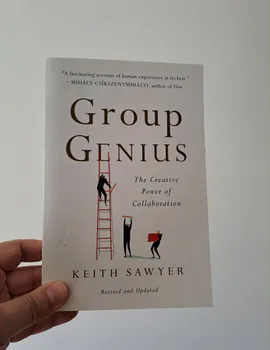
Group Genius: The Creative Power of Collaboration by Keith Sawyer is one of the most influential books on creativity, innovation, and teamwork. Sawyer, a creativity researcher and professor, challenges the traditional belief that breakthroughs come from isolated “geniuses” and argues that innovation is fundamentally a social process.
What the book is about
Section titled “What the book is about”Sawyer explores how creativity actually happens by studying:
- Jazz ensembles
- Improvisational theatre groups
- Scientific communities
- Product development teams
- Groundbreaking inventions and innovations
He demonstrates that many famous innovations, such as technologies and products we take for granted today, emerged through networks of contributors rather than a single inventor.
The book introduces concepts such as:
1. Collaborative Emergence
Section titled “1. Collaborative Emergence”Ideas are not fully formed from the start.
Instead, teams create value through:
- Discussion
- Experimentation
- Feedback
- Building on partial ideas
Just as jazz musicians create music together in real time, innovative teams create solutions through ongoing interaction.
2. Improvisation as a Model for Innovation
Section titled “2. Improvisation as a Model for Innovation”Sawyer is strongly influenced by jazz and improv theatre.
He argues that:
- Innovation is rarely linear.
- Planning is important, but excessive planning can limit creativity.
- Teams should be prepared to adapt and evolve ideas as new information emerges.
3. The Myth of Brainstorming
Section titled “3. The Myth of Brainstorming”The book critiques traditional brainstorming methods.
Instead of relying solely on idea-generation sessions, creative organisations:
- Encourage continuous conversations.
- Promote knowledge sharing.
- Support experimentation.
- Allow ideas to mature over time.
4. Innovation Ecosystems
Section titled “4. Innovation Ecosystems”Creativity happens within systems.
The most innovative organisations create:
- Trust
- Psychological safety
- Cross-functional collaboration
- Open communication channels
The focus shifts from individual brilliance to collective intelligence.
Core takeaway
Section titled “Core takeaway”The central idea is:
Great ideas emerge from collaboration, interaction, and continuous improvisation rather than from lone individuals working in isolation.
Sawyer argues that the popular “lone genius” narrative is largely a myth. Even seemingly individual achievements are built upon conversations, prior ideas, communities, organisations, and networks of people. Creativity is an emergent phenomenon that develops when people build on each other’s contributions over time.
In practical terms:
- Innovation is usually collective, not individual.
- Breakthroughs emerge through iteration, not sudden inspiration.
- Successful teams create environments where ideas can evolve organically.
- Improvisation is a critical skill for innovation.
- The best organisations focus on enabling creative interactions rather than trying to find “genius” employees.
Why it matters
Section titled “Why it matters”1. Changes How We Think About Innovation
Section titled “1. Changes How We Think About Innovation”Many organisations still reward individual achievement while expecting collaborative innovation.
Sawyer shows that:
- Innovation is a team sport.
- Organisations should optimise for collaboration rather than heroics.
This is particularly relevant for modern software, AI, and product teams.
2. Relevant for Agile and Modern Product Development
Section titled “2. Relevant for Agile and Modern Product Development”Given your interest in Agile, Scrum, AI agents, and software engineering, one of the book’s strongest messages is that innovation emerges through continuous inspection and adaptation.
Many of the book’s ideas align with:
- Agile principles
- Scrum teams
- DevOps culture
- Product discovery
- Design thinking
For example:
| Agile Principle | Group Genius Perspective |
|---|---|
| Iterative development | Creativity emerges through iteration |
| Self-organising teams | Innovation comes from interactions |
| Continuous feedback | Ideas improve through collaboration |
| Cross-functional teams | Diversity creates stronger outcomes |
3. Important for Leadership
Section titled “3. Important for Leadership”The book suggests that leaders should:
- Create conditions for collaboration.
- Remove barriers between teams.
- Encourage experimentation.
- Avoid micromanaging innovation.
A leader’s job is not to produce all the answers, but to create an environment where good ideas can emerge.
4. Highly Relevant in the AI Era
Section titled “4. Highly Relevant in the AI Era”Today, innovation increasingly occurs through collaboration between:
- Humans
- Teams
- AI systems
- Communities
- Open-source ecosystems
Ironically, the rise of AI makes Sawyer’s thesis even more relevant:
The future is unlikely to belong to isolated experts. It will belong to people and organisations that can effectively combine knowledge from diverse sources and collaborate at scale.
In summary:
Group Genius teaches that breakthrough innovation is not the product of solitary brilliance but the result of many people continuously building on one another’s ideas in an environment that supports collaboration, trust, and improvisation.
This is one of the most valuable mindset books because it reframes innovation from “find smart people” to “build systems where smart people can create together.”