Engineering DevOps
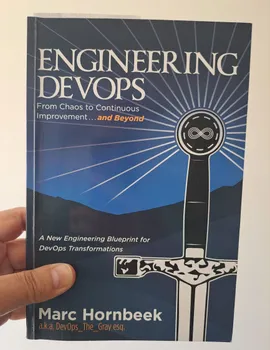
Engineering DevOps: From Chaos to Continuous Improvement… and Beyond by Marc Hornbeek is a substantial, engineering‑focused DevOps reference guide. It’s one of the few books that treats DevOps not as culture‑only or tooling‑only, but as a full engineering discipline with blueprints, maturity models, and prescriptive practices.
What the book is about
Section titled “What the book is about”1. Engineering DevOps foundations
Section titled “1. Engineering DevOps foundations”- Defines DevOps in engineering terms, not buzzwords.
- Introduces the DevOps Engineering Blueprint — a big‑picture architecture of all DevOps components.
- Presents the Nine Pillars of DevOps, a classification of practices used throughout the book.
2. People, processes, and technology engineering
Section titled “2. People, processes, and technology engineering”- DevOps maturity levels across People, Process, Technology.
- 27 DevOps Engineering Critical Success Factors.
- Engineering practices for:
- Value‑Stream Management (VSM)
- Application Release Automation (ARA)
- Version Management
- Continuous Security / DevSecOps
- Governance
- SRE
- Disaster mitigation & recovery
3. Engineering applications, pipelines, and infrastructure
Section titled “3. Engineering applications, pipelines, and infrastructure”- DevOps application engineering
- CI/CD pipeline engineering
- Elastic infrastructure engineering
- Continuous testing
- Continuous monitoring
- Continuous delivery & deployment
4. Seven‑step DevOps transformation blueprint
Section titled “4. Seven‑step DevOps transformation blueprint”A prescriptive transformation model:
- Visioning
- Alignment
- Assessment
- Solution Engineering
- Realization
- Operationalize
- Expansion
5. Continuous Flow → Continuous Feedback → Continuous Improvement
Section titled “5. Continuous Flow → Continuous Feedback → Continuous Improvement”Hornbeek aligns engineering practices with the Three Ways of DevOps, providing concrete engineering steps for each maturity stage.
Core takeaway
Section titled “Core takeaway”Hornbeek’s book is essentially a DevOps engineering manual: a structured, step‑by‑step blueprint for designing, implementing, and evolving DevOps in any organization — especially complex, legacy, multi‑team environments.
Why it matters
Section titled “Why it matters”- It fills a gap: most DevOps books are cultural, managerial, or tooling‑focused. This one is engineering‑prescriptive.
- It’s applicable to any starting point, including chaotic legacy environments.
- It complements enterprise‑scale DevOps books like DevOps Adoption Playbook and Lean Enterprise by giving the engineering “how” behind the transformation.
- It’s one of the most comprehensive DevOps engineering references (400 pages).