The Goal
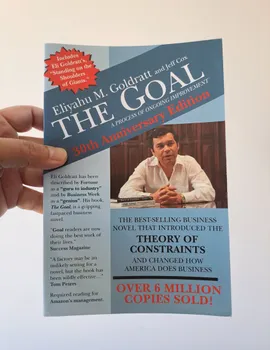
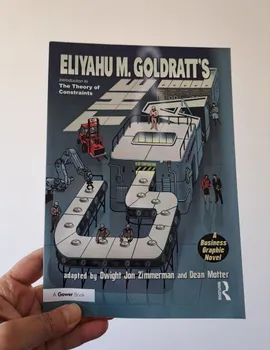
The Goal: A Process of Ongoing Improvement by Eliyahu M. Goldratt and Jeff Cox is considered one of the most influential business and operations management books ever written. It introduced the Theory of Constraints (TOC) to a wide audience through a novel-style story rather than a traditional business textbook.
What the book is about
Section titled “What the book is about”The story follows Alex Rogo, a plant manager whose manufacturing plant is performing poorly and is at risk of being shut down.
Alex is challenged to turn the plant around within a few months. Along the way, he is guided by a physicist and management thinker named Jonah (a character representing Goldratt’s ideas). Rather than giving direct answers, Jonah teaches Alex to think differently about how systems work.
As Alex investigates the plant’s problems, he discovers that:
- Most operational inefficiencies are symptoms, not root causes.
- Optimising every part of a system does not optimise the whole system.
- A few critical bottlenecks determine the performance of the entire operation.
- Traditional management metrics often drive the wrong behaviours.
The book follows Alex’s journey as he learns to identify and manage constraints, eventually saving the plant while applying the same thinking to his personal life.
Core takeaway
Section titled “Core takeaway”The central lesson is:
Every system has at least one constraint, and improving anything other than the constraint produces limited overall improvement.
In other words:
A chain is only as strong as its weakest link.
Most organisations spend enormous effort improving local efficiencies:
- Making machines faster
- Increasing employee utilisation
- Reducing costs in individual departments
- Measuring productivity department by department
But if those improvements do not address the system’s primary constraint, overall performance may barely improve.
Example
Section titled “Example”Imagine a factory with:
- Step A can produce 100 units/hour
- Step B can produce 50 units/hour
- Step C can produce 120 units/hour
The entire factory can only produce:
50 units/hour
because Step B is the bottleneck.
Improving Step A from 100 to 150 units/hour changes nothing.
Improving Step C from 120 to 200 units/hour changes nothing.
Improving Step B from 50 to 70 units/hour increases total system output.
This simple idea becomes the foundation of TOC.
The Theory of Constraints (TOC)
Section titled “The Theory of Constraints (TOC)”The book introduces the five focusing steps.
1. Identify the Constraint
Section titled “1. Identify the Constraint”Find the part of the system that limits throughput.
Possible constraints:
- A machine
- A team
- A policy
- A process
- A market
- A skill shortage
Question:
What prevents the system from achieving more of its goal?
2. Exploit the Constraint
Section titled “2. Exploit the Constraint”Make sure the constraint is never wasted.
Examples:
- Reduce downtime
- Prioritise important work
- Eliminate unnecessary interruptions
- Feed the constraint with work continuously
Before investing money, make better use of the existing constraint.
3. Subordinate Everything Else
Section titled “3. Subordinate Everything Else”Align the entire system around supporting the constraint.
This is one of the most counterintuitive concepts in the book.
Non-bottleneck resources should not always be running at 100%.
They should work at the pace that supports the bottleneck.
Otherwise:
- Excess inventory builds up
- Work-in-progress increases
- Lead times grow
- Complexity increases
4. Elevate the Constraint
Section titled “4. Elevate the Constraint”If needed, increase the constraint’s capacity through:
- New equipment
- Additional staff
- Automation
- Process redesign
Only do this after exploiting and subordinating.
Many companies jump straight to this step and waste money.
5. Repeat
Section titled “5. Repeat”Once one constraint is removed, another appears.
Improvement never ends.
Hence the subtitle:
“A Process of Ongoing Improvement”
Key Concept: The Goal
Section titled “Key Concept: The Goal”One of Jonah’s first questions is:
“What is the goal of the company?”
Many managers answer:
- Efficiency
- Productivity
- Quality
Jonah argues these are not the goal.
The goal of a for-profit business is:
To make money now and in the future.
Everything else should support that goal.
To measure progress, Goldratt introduces three metrics:
Throughput
Section titled “Throughput”Money generated through sales.
Not production.
Not inventory.
Sales.
Inventory
Section titled “Inventory”Money invested in things intended for sale.
Examples:
- Raw materials
- Work in progress
- Finished goods
Operating Expense
Section titled “Operating Expense”Money spent to turn inventory into throughput.
Examples:
- Labour
- Utilities
- Equipment operation
The ideal direction is:
- Increase Throughput
- Reduce Inventory
- Reduce Operating Expense
Many organisations focus excessively on cost reduction while ignoring throughput.
Why it matters
Section titled “Why it matters”1. It Changed How People Think About Systems
Section titled “1. It Changed How People Think About Systems”The book shifted management thinking from:
“Optimise every department”
to
“Optimise the entire system.”
This remains relevant in:
- Manufacturing
- Software development
- Project management
- Supply chains
- Healthcare
- Service industries
2. It Introduced Systems Thinking in a Practical Way
Section titled “2. It Introduced Systems Thinking in a Practical Way”Many organisations suffer from local optimisation.
Examples:
Software Teams
Section titled “Software Teams”Developers produce features faster than QA can test them.
Result:
- Larger backlogs
- Longer lead times
- No increase in delivered value
The bottleneck is QA, not development.
Scrum Teams
Section titled “Scrum Teams”Teams optimise story completion.
But releases depend on:
- Architecture reviews
- Security approval
- Production deployment
The real constraint may exist outside the team.
AI and Automation Projects
Section titled “AI and Automation Projects”A company automates document processing with AI.
But legal review remains manual.
The legal process becomes the new constraint.
Automating elsewhere delivers diminishing returns.
3. It Directly Influenced Modern Agile and Lean Thinking
Section titled “3. It Directly Influenced Modern Agile and Lean Thinking”Many concepts later embraced by:
- Lean Manufacturing
- Kanban
- DevOps
- Agile Delivery
- Value Stream Management
have strong alignment with ideas promoted in The Goal:
- Flow over utilisation
- System optimisation over local optimisation
- Limiting work in progress
- Identifying bottlenecks
- Continuous improvement
4. It Helps Managers Ask Better Questions
Section titled “4. It Helps Managers Ask Better Questions”Instead of asking:
How can everyone work harder?
The book encourages asking:
What is constraining the system?
This often reveals that:
- The issue is not effort.
- The issue is flow.
Bottom Line
Section titled “Bottom Line”One of the most valuable lessons is:
Every delivery system has a constraint, and finding that constraint is usually more valuable than optimising individual tasks.
For example, in a software organisation:
- Coding may not be the constraint.
- Testing may not be the constraint.
- Deployment approvals may not be the constraint.
The true bottleneck might be:
- Product decision-making
- Requirement clarification
- Security review
- Access management
- Environment provisioning
Many engineering leaders spend years optimising the wrong part of the system.
In summary:
The Goal teaches that organisational performance is determined by the system’s primary constraint, and the fastest path to improvement is to identify, manage, and continuously improve that constraint rather than attempting to optimise everything at once.