The Professional Product Owner
The Professional Product Owner
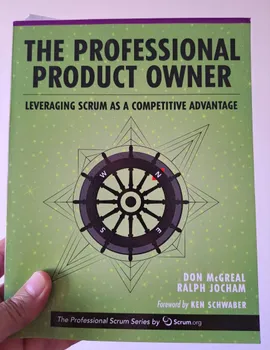
The Professional Product Owner: Leveraging Scrum as a Competitive Advantage by Don McGreal and Ralph Jocham is a well‑known, highly regarded book in the Scrum community. It’s part of the Professional Scrum Series and is often recommended for anyone who wants to deeply understand the Product Owner role beyond the basics.
What the book is about
Section titled “What the book is about”1. The Product Owner as a value maximizer
Section titled “1. The Product Owner as a value maximizer”The authors emphasize that the Product Owner is the single person accountable for maximizing product value — not a requirements writer, not a project manager, but a strategic business leader.
They highlight skills such as market understanding, stakeholder alignment, decision‑making, and entrepreneurial thinking.
2. Vision, Value, and Validation (the “Three Vs”)
Section titled “2. Vision, Value, and Validation (the “Three Vs”)”A major theme is the connection between:
- Vision — clear direction aligned with business goals
- Value — prioritizing what matters most
- Validation — empirically checking whether the product is delivering value
This is tied to Evidence‑Based Management (EBMgt), which the book promotes as a way to measure outcomes and guide decisions.
3. Agile product management vs project management
Section titled “3. Agile product management vs project management”The book strongly contrasts product mindset with project mindset:
- Project mindset → scope, deadlines, budget
- Product mindset → continuous value delivery, customer outcomes
This shift is foundational to modern Agile product development.
4. Backlog management as a strategic activity
Section titled “4. Backlog management as a strategic activity”The authors go deep into:
- Ordering by value, risk, and impact
- Refinement techniques
- Story mapping and impact mapping
- Ensuring transparency and shared understanding
Backlog management is presented as the core tactical tool of the Product Owner.
5. Release strategies and value delivery
Section titled “5. Release strategies and value delivery”They argue for:
- Frequent releases
- Empirical inspection
- Built‑in quality
- Clear Definition of Done
This aligns with Scrum’s emphasis on delivering usable increments every Sprint.
6. Scaling product ownership
Section titled “6. Scaling product ownership”The book discusses the challenges of scaling Scrum and product ownership across multiple teams, stressing coordination, clarity of vision, and maintaining value focus.
7. Stakeholder engagement
Section titled “7. Stakeholder engagement”The Product Owner must act as a bridge between business and development, ensuring alignment, transparency, and continuous feedback.
Core takeaway
Section titled “Core takeaway”The book is a comprehensive guide to professional product ownership, focusing on maximizing value, strengthening strategic alignment, and using Scrum empirically to gain competitive advantage.
Why it matters
Section titled “Why it matters”It’s one of the few books that:
- Treats the Product Owner as a strategic role, not a clerical one
- Connects Scrum with business outcomes
- Provides practical tools (EBMgt, mapping techniques, backlog strategies)
- Aligns closely with Scrum.org’s interpretation of Scrum