Joy, Inc.
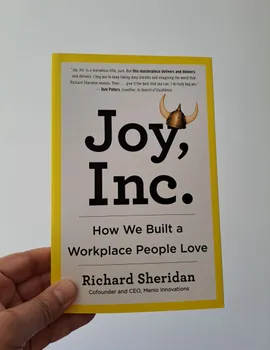
Joy, Inc.: How We Built a Workplace People Love by Richard Sheridan is a well-known leadership and workplace culture book based on Sheridan’s experience building Menlo Innovations, a software company in Ann Arbor, Michigan, with the explicit goal of creating joy at work.
What the book is about
Section titled “What the book is about”The book tells the story of how Sheridan and his team built Menlo Innovations differently from traditional companies.
Instead of focusing primarily on:
- Hierarchies
- Individual performance
- Status
- Internal politics
they focused on creating a workplace where people:
- Enjoy coming to work
- Feel psychologically safe
- Learn continuously
- Collaborate openly
- Deliver meaningful value to customers
Some of the practices discussed include:
1. Pairing People Together
Section titled “1. Pairing People Together”Rather than having employees work alone, Menlo often pairs people to work side-by-side.
Benefits:
- Faster learning
- Better quality
- Shared ownership
- Reduced knowledge silos
- Less dependence on “heroes”
2. Radical Transparency
Section titled “2. Radical Transparency”Information is made visible to everyone.
The philosophy is:
Hidden information creates anxiety. Visible information creates trust.
3. Human-Centred Leadership
Section titled “3. Human-Centred Leadership”Managers are not controllers.
Their role is to:
- Support teams
- Remove obstacles
- Create conditions for success
4. Customer Joy
Section titled “4. Customer Joy”Sheridan emphasizes that joy is not only for employees.
The goal is to create joy for:
- Employees
- Customers
- End users
If customers love the outcome and employees enjoy creating it, the organisation thrives.
5. Experimentation Over Perfection
Section titled “5. Experimentation Over Perfection”The company embraces:
- Fast feedback
- Iterative learning
- Safe mistakes
People are encouraged to learn rather than defend themselves.
6. Culture by Design
Section titled “6. Culture by Design”One of Sheridan’s strongest arguments is that culture should never be left to chance.
Every process, workspace design, meeting structure, and leadership behaviour should intentionally reinforce the culture you want.
Core takeaway
Section titled “Core takeaway”The central message of the book is:
Joy in the workplace is not an accident. It can be intentionally designed into an organisation through culture, leadership, transparency, collaboration, and the elimination of fear.
Sheridan argues that most workplaces are dominated by fear:
- Fear of making mistakes
- Fear of looking incompetent
- Fear of management
- Fear of change
- Fear of losing status or control
When fear is removed and replaced with trust, collaboration, and purpose, people become more engaged, innovative, productive, and satisfied with their work. The result is not only happier employees but also stronger business performance.
In one sentence:
Business success is a by-product of creating an environment where people genuinely enjoy contributing and helping one another succeed.
Why it matters
Section titled “Why it matters”1. It Challenges Traditional Management Thinking
Section titled “1. It Challenges Traditional Management Thinking”Many organisations still operate on assumptions such as:
- People need to be tightly managed.
- Productivity comes from pressure.
- Individual competition drives performance.
Sheridan presents an alternative view:
Sustainable performance comes from trust, collaboration, and shared purpose.
2. It Connects Culture to Business Results
Section titled “2. It Connects Culture to Business Results”The book is not merely about making employees happy.
Its argument is:
A healthy culture produces better outcomes.
When people are:
- Engaged
- Energised
- Connected
they typically:
- Create higher-quality work
- Innovate more
- Retain knowledge better
- Stay longer
This creates long-term competitive advantage.
3. It Provides Practical Examples
Section titled “3. It Provides Practical Examples”Unlike many leadership books that remain theoretical, Joy, Inc. explains specific practices that Sheridan implemented.
Readers can evaluate:
- Pair programming
- Visual work management
- Open workplaces
- Collaborative decision-making
- Customer-focused design
and adapt those ideas to their own organisations.
4. It Is Particularly Relevant for Agile and Knowledge Work
Section titled “4. It Is Particularly Relevant for Agile and Knowledge Work”This book aligns extremely well with modern product development environments.
Many ideas in the book reinforce principles found in:
- Agile
- Lean
- XP (Extreme Programming)
- Human-centred design
You will notice parallels with:
- Cross-functional teams
- Transparency
- Continuous feedback
- Psychological safety
- Collective ownership
In summary:
Joy, Inc. is a case study in building a high-performing organisation by deliberately creating joy rather than treating employee happiness as a side benefit. Sheridan argues that fear is the hidden cost in most companies, and that replacing it with transparency, collaboration, trust, and meaningful work leads to better products, better teams, and better business outcomes. The book is less about perks and more about designing systems and behaviours that allow people to do their best work together.
For leaders, Scrum Masters, Engineering Managers, Agile Coaches, and founders, it is one of the stronger culture-focused books because it combines philosophy with concrete operational practices.