The Principles of Product Development Flow
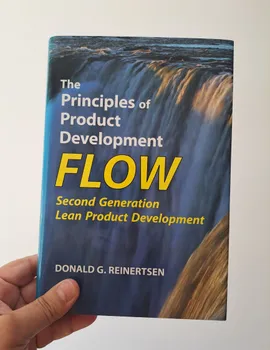
The Principles of Product Development Flow: Second Generation Lean Product Development by Donald G. Reinertsen is one of the most influential and rigorous books in modern product development. It’s dense, highly analytical, and grounded in economics, queueing theory, and flow science. It’s also one of the core texts behind Lean, Kanban, DevOps, and modern flow‑based delivery.
What the book is about
Section titled “What the book is about”- It challenges traditional, manufacturing‑inspired approaches to product development, showing why they fail in high‑variability, high‑uncertainty environments.
- It introduces a flow‑based paradigm that focuses on queues, variability, batch sizes, WIP limits, and cost‑of‑delay.
- It provides practical, economically grounded principles for improving throughput, reducing cycle time, and making better decisions.
Key concepts
Section titled “Key concepts”- Cost of Delay — the single most important economic metric; quantify it or you’re flying blind.
- Queues — invisible queues create most waste; high utilization makes queues explode.
- Variability — not always bad; sometimes variability increases economic value.
- Batch Size Reduction — smaller batches accelerate feedback and reduce cycle time.
- WIP Constraints — controlling WIP directly controls cycle time.
- Fast Feedback — essential for adaptive control in uncertain environments.
- Decentralized Control — teams must make local decisions quickly based on economic models.
Core takeaway
Section titled “Core takeaway”Reinertsen argues that flow, not “process compliance,” is the true driver of speed, quality, and economic performance in product development. The book introduces 175 principles that replace intuition and tradition with quantitative, economic decision‑making.
Why it matters
Section titled “Why it matters”It provides the mathematical and economic foundation behind many practices:
- WIP limits in Kanban
- Small batches in CI/CD
- Cost‑of‑delay in prioritization
- Fast feedback loops in Agile
- Decentralized decision‑making in DevOps
- Flow optimization in AI/LLM pipelines
It’s the book that explains why these practices work.
High‑level structure
Section titled “High‑level structure”Reinertsen organizes the 175 principles into eight domains:
- Economics
- Queues
- Variability
- Batch Size
- WIP Constraints
- Cadence & Synchronization
- Fast Feedback
- Decentralized Control
Each principle is concise, actionable, and grounded in economics.