Leading the Transformation
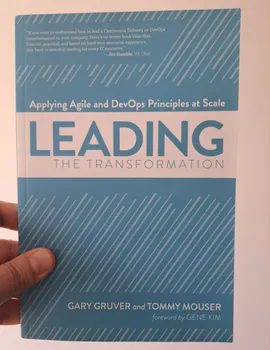
It’s one of the most executive‑focused, practical, and high‑leverage Agile/DevOps transformation books published in the last decade.
It sits in the same transformation space as Perkin’s Agile Transformation and Cobb’s Mastering Agile, but with a much more operational, engineering‑centric, and DevOps‑driven perspective.
What the book is about
Section titled “What the book is about”- It argues that team‑level Agile is insufficient for large organizations; executives must redesign how work flows across the entire system.
- It provides a framework for enterprise‑level continuous improvement, planning, and DevOps scaling.
- It emphasizes trunk‑based development, gated commits, and automated testing as the backbone of stability and speed.
- It shows how HP (LaserJet Firmware) cut development costs in half and increased innovation from 5% to 40% by applying these principles.
- It’s written specifically for executives, not Scrum Masters or team‑level coaches.
Key ideas
Section titled “Key ideas”- Enterprise‑level continuous improvement — replacing local optimizations with system‑wide flow improvements.
- Agile enterprise planning — planning in tiers, limiting long‑range commitments.
- Scaling DevOps — frequent, economical releases through automation and stable architecture.
- Culture of trunk development — gated commits, stable mainline, rapid feedback.
- Deployment pipeline design — fast localization of issues, automated qualification.
- Statistical test management — using defect statistics to improve stability over time.
Chapter structure
Section titled “Chapter structure”- Understanding the Transformation
- Challenges with Scaling Agile Teams
- Business Objectives & First Steps
- Enterprise‑Level Continuous Improvement
- Agile Enterprise Planning
- Business Objectives for Scaling DevOps
- Creating a Culture of Trunk Development
- Ensuring a Solid Foundation
- Continuous Delivery
- Designing the Deployment Pipeline
- Improving Stability Over Time
- Getting Started
Core takeaway
Section titled “Core takeaway”Leading the Transformation is a short, executive‑level playbook showing how to scale Agile and DevOps across large enterprises by focusing on coordination across teams, stable trunk‑based development, continuous delivery, and statistical process control — not just team‑level Agile ceremonies.