Turn the Ship Around!
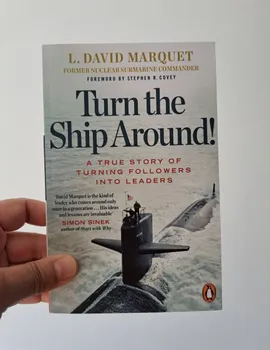
Turn the Ship Around!: A True Story of Turning Followers into Leaders by L. David Marquet is widely regarded as one of the most influential modern leadership books. It is based on Marquet’s real experience as captain of the USS Santa Fe, a nuclear submarine that went from being one of the worst-performing vessels in the U.S. Navy to one of the best after he fundamentally changed the way leadership was practised.
What the book is about
Section titled “What the book is about”The book tells the story of Marquet taking command of the USS Santa Fe.
He had spent a year preparing to command a different submarine but was unexpectedly assigned to the Santa Fe. As a result, he was no longer the most technically knowledgeable person on board. During an early exercise, he gave an order that was impossible on that submarine. Shockingly, his crew started trying to execute it anyway simply because the captain had said so. That moment exposed the danger of blind obedience.
Marquet realised that:
- The crew had been conditioned to obey instead of think.
- The traditional command-and-control structure discouraged initiative.
- A single leader could become a bottleneck and a point of failure.
Rather than becoming more controlling, he did something unusual:
- He gave more control to the crew.
- He encouraged independent thinking.
- He required sailors to explain their intent.
- He made leadership everyone’s responsibility.
The result was dramatic improvements in morale, performance, learning, and retention. The submarine eventually became one of the highest-performing in the fleet.
Core takeaway
Section titled “Core takeaway”The central idea of the book is:
Stop creating followers. Start creating leaders.
Traditional organisations often operate using a leader-follower model:
- Leaders think.
- Leaders make decisions.
- Followers execute orders.
Marquet argues that this model creates dependency, reduces initiative, and limits organisational performance. Instead, he proposes a leader-leader model, where authority, ownership, and decision-making are pushed to the people closest to the work.
The goal is not to eliminate leadership. Instead, it is to distribute leadership throughout the organisation.
A practical example from the book is replacing:
“Request permission to do X.”
with:
“I intend to do X.”
This small language change forces people to think, analyse, and take responsibility before acting.
Three pillars of the Leader-Leader model
Section titled “Three pillars of the Leader-Leader model”Marquet’s framework rests on three elements:
-
Control
- Push decision-making down the hierarchy.
- Give people ownership of their work.
-
Competence
- Ensure individuals have the knowledge and skills to make good decisions.
- Empowerment without competence creates chaos.
-
Clarity
- Make sure everyone understands the mission and purpose.
- When people know the intent, they can make independent decisions aligned with organisational goals.
Why it matters
Section titled “Why it matters”1. Most organisations still operate like the “leader-follower” model
Section titled “1. Most organisations still operate like the “leader-follower” model”Many companies unknowingly create environments where employees wait for instructions.
Common symptoms include:
- Constant approval chains.
- Micromanagement.
- Managers becoming bottlenecks.
- Teams that cannot act without permission.
Marquet’s approach addresses these problems directly.
2. Knowledge workers are closer to the information
Section titled “2. Knowledge workers are closer to the information”In modern software development, AI engineering, product development, and technical teams, the people doing the work often understand the details better than senior managers.
The person nearest the problem frequently has the best information to solve it.
The book argues that decisions should therefore be made as close as possible to the work itself.
3. It creates scalable leadership
Section titled “3. It creates scalable leadership”Many organisations fail because everything depends on a few leaders.
Leader-follower systems scale poorly because every decision must move upward.
Leader-leader systems scale better because:
- More people can make decisions.
- Problems are solved faster.
- Leadership survives personnel changes.
- Teams become more resilient.
4. It aligns well with Agile and modern product teams
Section titled “4. It aligns well with Agile and modern product teams”If you’re familiar with:
- Scrum
- Agile
- DevOps
- Self-managing teams
you’ll recognise many parallels.
The book promotes:
- Autonomy
- Accountability
- Continuous learning
- Distributed decision-making
These are foundational principles behind high-performing Agile organisations.
In summary:
The book demonstrates that the highest-performing organisations are not built by creating better followers, but by creating more leaders who understand the intent, possess the competence, and have the authority to act.