Difficult Conversations
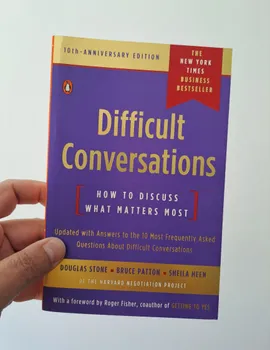
Difficult Conversations: How to Discuss What Matters Most is one of the foundational works in modern negotiation and interpersonal communication, written by Douglas Stone, Bruce Patton, and Sheila Heen, all members of the Harvard Negotiation Project. It’s widely considered the companion text to Fisher & Ury’s Getting to Yes, but focused on the human, emotional, and identity-driven side of conflict.
What the book is about
Section titled “What the book is about”- What Happened Conversation — facts, blame, intentions. We confuse impact with intent, assume motives, and argue about “truth.”
- Feelings Conversation — unspoken emotions (anger, fear, disappointment) that leak out as defensiveness or avoidance.
- Identity Conversation — the internal struggle: Am I competent? A good person? Worthy? This is why small conflicts feel huge.
Key practices
Section titled “Key practices”- Shift from certainty to curiosity — treat your conclusions as hypotheses.
- Trade blame for contribution — ask “How did each of us contribute to this situation?” instead of “Whose fault is it?”
- Start with the Third Story — describe the situation the way a neutral observer would.
- Disentangle intent from impact — describe how you were affected without assuming motives.
- Express feelings clearly and responsibly — instead of suppressing them.
Core takeaway
Section titled “Core takeaway”The book teaches that every difficult conversation is actually three conversations happening at once — the What Happened, Feelings, and Identity conversations — and that most people only address the first one, which is why conflict spirals.
Why it matters
Section titled “Why it matters”It gives a repeatable framework for:
- giving and receiving feedback
- resolving team conflict
- navigating misalignment with product, leadership, or stakeholders
- handling emotionally charged conversations without escalation
It directly addresses the psychology behind communication breakdowns, not just the techniques.