Hooked
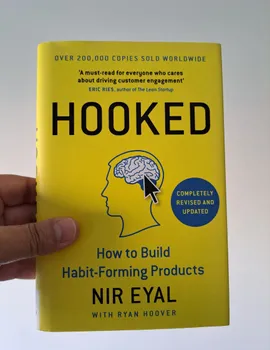
Hooked: How to Build Habit‑Forming Products by Nir Eyal is one of the foundational books in modern product management and behavioral design. At its core, the book teaches how products like Instagram, TikTok, Slack, or Duolingo become part of users’ routines by repeatedly cycling them through the Hook Model: Trigger → Action → Variable Reward → Investment.
What the book is about
Section titled “What the book is about”Eyal argues that the most successful digital products don’t win because of features — they win because they form habits. A habit is an automatic behavior triggered by a cue, and once a product becomes the “first‑to‑mind” solution for boredom, curiosity, loneliness, or uncertainty, users return without external prompts.
The book explains:
- Triggers — external (notifications) and internal (emotions) prompts that start the behavior.
- Actions — the simplest behavior a user performs in anticipation of a reward.
- Variable rewards — unpredictable outcomes that create craving and attention.
- Investment — small user contributions (time, data, content, reputation) that increase future engagement.
It also emphasizes the ethical responsibility of designing habit‑forming products, warning against manipulation.
Why it matters
Section titled “Why it matters”It provides a mental model for:
- Designing features that users return to naturally
- Increasing retention without relying on marketing
- Understanding the psychology behind engagement loops
- Evaluating whether a product idea has habit‑forming potential
- Distinguishing between healthy habits and exploitative ones
Key takeaways
Section titled “Key takeaways”- Habit‑forming products create mind monopolies — they become the default solution for a recurring user need.
- Variable rewards are the engine of engagement — predictable rewards don’t create habits.
- Investment increases switching costs — the more users put in, the more they return.
- Ethical design is essential — habits can help or harm depending on intent.