Team Mastery
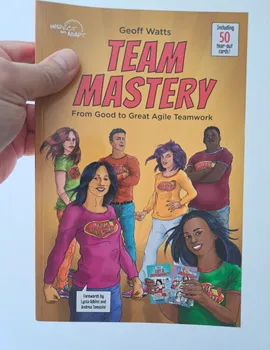
Team Mastery: From Good to Great Agile Teamwork by Geoff Watts, it’s one of his most practical, team‑focused books. Team Mastery follows the same coaching philosophy as Scrum Mastery but shifts the lens from the Scrum Master role to the team as a living system.
What the book is about
Section titled “What the book is about”Because Geoff Watts writes in trilogies (Scrum Mastery, Product Mastery, Team Mastery), we can confidently outline the themes he uses across all three:
1. Team Development Stages
Section titled “1. Team Development Stages”Watts typically blends Tuckman’s model (Forming → Storming → Norming → Performing) with Agile coaching behaviors, helping teams diagnose where they are and what interventions help them progress.
2. Psychological Safety
Section titled “2. Psychological Safety”A major theme in all his writing. He emphasizes:
- candor
- vulnerability
- conflict as a growth mechanism
- trust‑building rituals
3. Self‑Management Patterns
Section titled “3. Self‑Management Patterns”Watts teaches teams how to:
- make decisions without escalation
- distribute leadership
- handle conflict internally
- create working agreements that evolve
4. Team Coaching Techniques
Section titled “4. Team Coaching Techniques”Expect practical tools such as:
- Left‑Hand Column (from Argyris)
- Clean Language questions
- Delegation Poker
- Retrospective formats for maturity growth
5. The RE‑TRAINED Model Applied to Teams
Section titled “5. The RE‑TRAINED Model Applied to Teams”In Scrum Mastery, RE‑TRAINED describes great servant‑leaders.
In Team Mastery, Watts adapts the same attributes to team behaviors:
- Respected → integrity & reliability
- Enabling → helping each other succeed
- Tactful → constructive conflict
- Resourceful → creative problem‑solving
- Alternative → challenging norms
- Inspiring → motivating peers
- Nurturing → supporting growth
- Empathetic → human‑centered collaboration
- Disruptive → breaking unhelpful patterns
Core takeaway
Section titled “Core takeaway”Team Mastery is a guide to helping Agile teams evolve from functional groups to genuinely high‑performing, self‑managing units, using patterns from coaching psychology, systems thinking, and Watts’ RE‑TRAINED leadership model.
(This is an inference based on Watts’ documented frameworks in Scrum Mastery and Product Mastery.)
Why it matters
Section titled “Why it matters”- It fills a gap: most Agile books focus on roles, not the team as a system.
- It provides practical exercises teams can use immediately.
- It helps teams move beyond “good enough” Scrum into high‑trust, high‑accountability collaboration.
- It aligns strongly with modern Agile thinking (Team Topologies, Argyris, Lencioni, Sinek).