Silos, Politics and Turf Wars
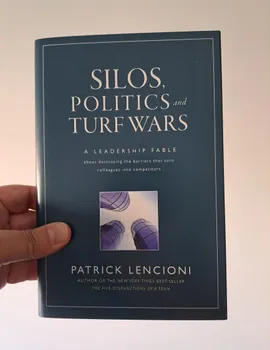
Silos, Politics and Turf Wars is one of Patrick Lencioni’s most practical and immediately applicable leadership fables. It tackles a problem you’ve definitely seen in real organizations: departments acting like rival tribes instead of parts of the same team.
What the book is about
Section titled “What the book is about”Like Lencioni’s other works, it’s written as a leadership fable. The protagonist, Jude Cousins, is a consultant who works with several organizations suffering from silo behavior — a hotel, a hospital, a fitness equipment manufacturer, and even a church. Through these engagements, he discovers that:
- Silos emerge when leaders fail to provide a compelling context for collaboration.
- Employees actually want to work well together — they suffer the most from departmental politics.
- A crisis naturally eliminates silos because everyone aligns around one urgent goal.
- Leaders can manufacture that same alignment without needing a real crisis by defining a thematic goal.
The model Lencioni proposes
Section titled “The model Lencioni proposes”Each organization must define:
- Thematic Goal — a single, qualitative, time‑bound priority.
- Defining Objectives — the components of the thematic goal.
- Standard Operating Objectives — ongoing responsibilities that support the goal.
- Metrics and Scorecards — weekly tracking to maintain alignment.
This structure forces leaders to think and act as one team instead of defending their departmental turf.
Core takeaway
Section titled “Core takeaway”The core idea is simple: silos don’t form because people are petty — they form because leaders fail to create a shared, unifying context. When every department optimizes for its own goals, colleagues become competitors.
The book argues that the only reliable way to break down silos is to create a single, time‑bound, qualitative priority — what Lencioni calls a Thematic Goal — that every leader must own together, regardless of department.
Without this shared rallying cry, politics and turf wars are inevitable.
Why it matters
Section titled “Why it matters”If you’re working in environments with cross‑functional friction — product vs. engineering, sales vs. marketing, operations vs. finance — this book gives you:
- A diagnostic lens to identify silo behavior.
- A practical framework to eliminate it.
- A leadership tool to create alignment without needing a crisis.
It pairs well with Lencioni’s other works, especially The Five Dysfunctions of a Team, because both emphasize clarity, trust, and shared purpose.