Leaders Eat Last
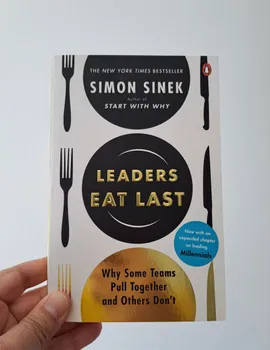
Leaders Eat Last: Why Some Teams Pull Together and Others Don’t by Simon Sinek is one of the most influential modern leadership books. It explores why some organizations create loyal, high-performing teams while others struggle with distrust, politics, and disengagement.
What the book is about
Section titled “What the book is about”The book examines leadership through a combination of:
- Human biology
- Psychology
- Anthropology
- Military examples
- Business case studies
1. Humans Are Wired for Cooperation
Section titled “1. Humans Are Wired for Cooperation”Sinek explains that humans evolved in tribes. Survival depended on belonging to a group that protected its members.
Even though modern workplaces are different from ancient tribes, our brains still seek:
- Safety
- belonging
- trust
- social connection
When these needs are met, people naturally cooperate. When they are absent, people become defensive and competitive.
2. The Circle of Safety
Section titled “2. The Circle of Safety”One of the book’s most important concepts is the Circle of Safety.
Leaders create an environment where team members feel protected from:
- Internal politics
- Fear-based management
- Blame culture
- Unnecessary competition
When employees feel protected, they are more willing to support each other and focus on shared goals.
3. Leadership Is Service, Not Authority
Section titled “3. Leadership Is Service, Not Authority”Sinek challenges the common belief that leadership is about power or rank.
Instead:
- Being “in charge” gives privileges.
- Being a leader creates responsibilities.
The higher someone rises in an organization, the more responsibility they have to care for others.
4. Biology Influences Workplace Behaviour
Section titled “4. Biology Influences Workplace Behaviour”A unique aspect of the book is how it links leadership to brain chemistry.
Sinek discusses chemicals such as:
- Dopamine: rewards achievement and goal completion
- Endorphins: help us push through challenges
- Serotonin: associated with pride and status
- Oxytocin: associated with trust, empathy, and human connection
- Cortisol: the stress hormone
Organizations that constantly create fear and pressure increase cortisol levels. Organizations that foster trust increase oxytocin, which promotes cooperation.
5. Long-Term Success Beats Short-Term Results
Section titled “5. Long-Term Success Beats Short-Term Results”Many organizations focus excessively on:
- Quarterly numbers
- Immediate profits
- Short-term performance
Sinek argues that sustainable success comes from investing in people first. When employees feel valued and supported, business performance improves as a natural consequence.
Core takeaway
Section titled “Core takeaway”The central message is:
Great leaders put the well-being of their people before their own interests.
The title comes from a tradition in the U.S. Marine Corps where officers eat only after their troops have eaten. The idea is symbolic: true leaders are willing to sacrifice personal comfort, status, or short-term gain to protect and support those they lead.
Sinek argues that when leaders create what he calls a “Circle of Safety”, people feel secure enough to:
- Trust one another
- Collaborate openly
- Take risks
- Innovate
- Focus on the mission rather than self-preservation
When people feel unsafe, they spend energy protecting themselves instead of helping the team or organization succeed.
Why it matters
Section titled “Why it matters”1. It Reframes Leadership
Section titled “1. It Reframes Leadership”Many people equate leadership with:
- Authority
- Job title
- Decision-making power
The book reframes leadership as:
Responsibility + Sacrifice + Service
This mindset shift is valuable for managers, team leads, executives, Scrum Masters, Product Owners, and anyone influencing others.
2. It Explains Why Culture Matters
Section titled “2. It Explains Why Culture Matters”The book makes a compelling case that culture is not a “soft” topic.
A healthy culture directly impacts:
- Employee engagement
- Retention
- Innovation
- Productivity
- Customer satisfaction
Trust becomes a business advantage.
3. It Is Highly Relevant to Modern Organizations
Section titled “3. It Is Highly Relevant to Modern Organizations”Many current workplace challenges stem from:
- Burnout
- Lack of trust
- Remote work disconnection
- Internal competition
- Fear-based management
Sinek’s framework helps explain why these problems occur and how leaders can address them.
4. It Aligns with Agile and Modern Team Practices
Section titled “4. It Aligns with Agile and Modern Team Practices”Given your interest in Agile, Scrum, and leadership, this book connects strongly with principles such as:
- Servant Leadership
- Psychological Safety
- Self-organizing teams
- Continuous improvement
- Empowerment over command-and-control
In many ways, Leaders Eat Last provides the human and psychological foundation behind why Agile teams perform better when trust and safety are present.
In summary:
People do their best work when they feel safe, trusted, and valued, and the primary responsibility of a leader is to create that environment.