The DevOps Handbook
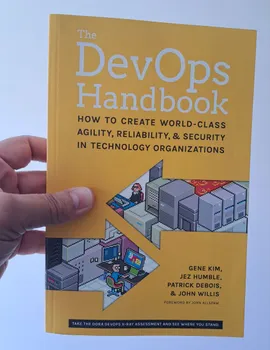
The DevOps Handbook is one of the foundational works in modern DevOps literature, and based on the sources, it remains one of the most cited, practical, and influential guides for transforming technology organizations.
What the book is about
Section titled “What the book is about”1. The Three Ways of DevOps
Section titled “1. The Three Ways of DevOps”- Flow — Optimize the path from idea → code → production by reducing batch sizes, eliminating handoffs, and improving deployment lead time.
- Feedback — Build fast, amplified feedback loops through monitoring, automated testing, telemetry, and blameless postmortems.
- Continuous Learning & Experimentation — Create a learning organization that treats failures as data, encourages experimentation, and continuously improves.
These principles map directly to Lean concepts (Just‑In‑Time, Jidoka, Kaizen).
2. Value streams and high‑velocity organizations
Section titled “2. Value streams and high‑velocity organizations”The book emphasizes optimizing end‑to‑end value streams, not isolated silos.
Techniques include:
- Making work visible
- Limiting WIP
- Identifying bottlenecks (environment provisioning, test speed, deployment automation)
- Measuring lead time and “percent complete and accurate”
Case studies (e.g., CSG, Nordstrom) show how organizations move from multi‑week releases to daily deployments.
3. Culture and organizational design
Section titled “3. Culture and organizational design”The authors highlight Westrum’s generative culture as the foundation of DevOps success:
- Psychological safety
- Blameless postmortems
- Shared responsibility
- Breaking down dev/ops/security silos
This cultural layer is often more important than tooling.
4. Technical practices
Section titled “4. Technical practices”The book provides detailed guidance on:
- Infrastructure as Code
- Automated testing
- Continuous Integration / Continuous Delivery
- Deployment pipelines
- Monitoring & logging
These practices support low‑risk releases and rapid recovery.
5. Architecting for safe, low‑risk releases
Section titled “5. Architecting for safe, low‑risk releases”Techniques include:
- Feature flags
- Blue/green deployments
- Canary releases
- Small batch sizes
- Immutable infrastructure
These patterns allow organizations to deploy frequently without sacrificing reliability.
6. Security as a first‑class citizen
Section titled “6. Security as a first‑class citizen”The book integrates DevSecOps principles:
- Security automation
- Policy as code
- Embedding security early in the pipeline
- Continuous compliance
This aligns with John Willis’s strong DevSecOps background.
Core takeaway
Section titled “Core takeaway”The book teaches how high‑performing organizations achieve world‑class agility, reliability, and security by applying the Three Ways of DevOps — Flow, Feedback, and Continuous Learning — supported by automation, lean principles, systems thinking, and a generative culture.
Why it matters
Section titled “Why it matters”Across all sources, several themes stand out:
- It is one of the most influential DevOps books since 2016, with a major revised edition in 2021.
- It connects software delivery performance to organizational performance, supported by research from Nicole Forsgren (Accelerate, State of DevOps Reports).
- It provides actionable frameworks, not just theory.
- It complements The Phoenix Project by explaining the “Three Ways” in depth.
- It is widely used in enterprise DevOps transformations (Amazon, Google, Netflix, Etsy).