Drive
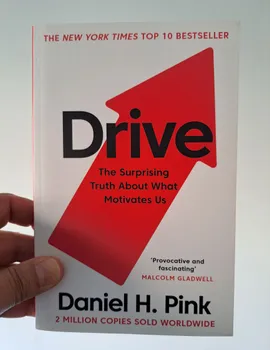
Drive: The Surprising Truth About What Motivates Us by Daniel H. Pink is a well‑known book, and its core argument is strongly supported by decades of behavioral science. The book overturns the classic carrot‑and‑stick model and introduces a new framework for human motivation built on autonomy, mastery, and purpose.
What the book is about
Section titled “What the book is about”The most important idea: external rewards often reduce performance for creative, cognitive, and complex work, and humans are actually driven far more by intrinsic motivation — the desire to direct our own lives, improve at meaningful things, and contribute to something larger.
Key concepts
Section titled “Key concepts”Motivation 1.0 → 2.0 → 3.0
Section titled “Motivation 1.0 → 2.0 → 3.0”Pink frames human motivation like software versions:
- Motivation 1.0 — biological survival drives.
- Motivation 2.0 — rewards and punishments (Industrial‑Era management).
- Motivation 3.0 — intrinsic motivation: autonomy, mastery, purpose.
Autonomy
Section titled “Autonomy”The desire to direct our own lives.
Pink breaks autonomy into four dimensions: task, time, technique, team.
Examples include Google’s 20% time and Atlassian’s FedEx Days.
Mastery
Section titled “Mastery”The urge to get better at something that matters.
It is a mindset, a painful process, and an asymptote — you never fully reach it.
Purpose
Section titled “Purpose”The yearning to serve something larger than ourselves.
Organizations that maximize purpose (e.g., open‑source communities) outperform those focused only on profit.
Why rewards often fail
Section titled “Why rewards often fail”Pink highlights research showing that external incentives can:
- Kill intrinsic motivation
- Reduce creativity
- Encourage cheating
- Promote short‑term thinking
- Become addictive
These effects are especially strong in modern, non‑routine, creative work.
Why it matters
Section titled “Why it matters”Drive is widely used in leadership, organizational design, and agile environments because it explains why traditional management systems fail in knowledge‑work settings.