Scrum
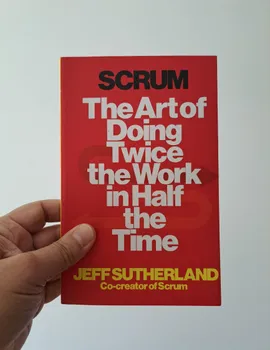
Scrum: The Art of Doing Twice the Work in Half the Time by Jeff Sutherland is one of the foundational books for understanding Agile thinking and the Scrum framework. While many people know Scrum as a software development methodology, the book is actually about a broader way of organising work that increases productivity, quality, and team satisfaction.
What the book is about
Section titled “What the book is about”The book explains:
The Origins of Scrum
Section titled “The Origins of Scrum”Sutherland begins by describing his experiences:
- As a fighter pilot
- As a software executive
- As one of the creators of Scrum
He observed the same problem everywhere:
Large projects often fail not because people are incompetent, but because the system of work is broken.
Traditional project plans regularly:
- Miss deadlines
- Exceed budgets
- Produce lower-quality results
Scrum was created as an alternative.
The Framework
Section titled “The Framework”The book introduces the core Scrum components.
Product Backlog
Section titled “Product Backlog”A prioritized list of everything that needs to be done.
Key idea:
- Focus on value first
- Do the most important work earliest
Sprint
Section titled “Sprint”A short time-boxed period, usually 1-4 weeks.
At the end of each sprint:
- Something useful is completed
- Progress is visible
- Feedback can be gathered
Instead of waiting a year for delivery, stakeholders see results every few weeks.
Daily Scrum
Section titled “Daily Scrum”A short daily meeting where the team aligns around:
- What was done yesterday?
- What will be done today?
- What obstacles exist?
Purpose:
- Improve coordination
- Remove blockers quickly
Sprint Review
Section titled “Sprint Review”The team demonstrates completed work.
Goal:
- Gather feedback
- Verify value delivered
Retrospective
Section titled “Retrospective”Perhaps the most important Scrum practice.
The team asks:
- What worked?
- What didn’t?
- What can we improve?
This creates continuous improvement.
Self-Managing Teams
Section titled “Self-Managing Teams”A major theme throughout the book is:
The people doing the work should decide how the work gets done.
Sutherland argues that excessive management often slows teams down.
High-performing teams typically have:
- Clear goals
- High trust
- Shared accountability
- Autonomy
Managers should focus on removing obstacles instead of directing every task.
Eliminating Waste
Section titled “Eliminating Waste”The book borrows heavily from Lean manufacturing principles.
Examples of waste:
Multitasking
Section titled “Multitasking”One of Sutherland’s strongest arguments.
Most people believe multitasking improves productivity.
Research shows the opposite:
- Switching context creates delays
- Mistakes increase
- Completion times grow
Scrum encourages teams to:
Finish work before starting new work.
Excessive Documentation
Section titled “Excessive Documentation”Documentation has value.
However, documents that nobody reads are waste.
The goal is:
Create only the documentation that delivers value.
Partially Completed Work
Section titled “Partially Completed Work”Work that is “90% done” is often worthless.
Customers receive value only from completed work.
Scrum focuses on delivering finished increments frequently.
Core takeaway
Section titled “Core takeaway”The central message is:
Most organisations waste enormous amounts of time through poor planning, multitasking, excessive management, and ineffective teamwork. By applying Scrum principles, teams can deliver significantly more value in less time while improving quality and employee happiness.
Sutherland argues that traditional project management is fundamentally flawed because it assumes that work can be fully planned upfront. In reality:
- Requirements change
- Customers change their minds
- Unexpected issues emerge
- Teams learn as they work
Instead of trying to create a perfect long-term plan, Scrum embraces uncertainty and adapts continuously.
The book’s core philosophy can be summarized as:
Inspect → Adapt → Improve → Repeat
Teams work in short cycles, learn from outcomes, and continuously adjust their approach.
Why it matters
Section titled “Why it matters”The book matters because it challenges many assumptions about work.
It Changes How You Think About Productivity
Section titled “It Changes How You Think About Productivity”Most organisations measure:
- Hours worked
- Effort spent
- Activity levels
Scrum focuses on:
- Outcomes
- Value delivered
- Customer impact
Busy does not equal productive.
This is one of the book’s most important lessons.
It Introduces a Scientific Approach to Work
Section titled “It Introduces a Scientific Approach to Work”Scrum treats work like an experiment.
Instead of saying:
“We know exactly what will happen.”
The team says:
“Let’s test, learn, and adapt.”
This mindset is valuable in:
- Software development
- Product management
- Marketing
- Manufacturing
- Education
- Personal projects
It Solves Coordination Problems
Section titled “It Solves Coordination Problems”Many organisations suffer from:
- Siloed departments
- Endless meetings
- Slow decision-making
Scrum creates alignment through:
- Shared goals
- Transparency
- Frequent feedback
This significantly improves execution speed.
It Encourages Continuous Improvement
Section titled “It Encourages Continuous Improvement”One of the most powerful ideas is:
Small Improvements Compound
Section titled “Small Improvements Compound”A team that improves by just a few percent every sprint can become dramatically more effective over time.
Sutherland frequently references the Japanese concept of:
Kaizen (continuous improvement)
The idea is:
Never accept that the current process is the best possible process.
It Focuses on Human Motivation
Section titled “It Focuses on Human Motivation”The book aligns with research on intrinsic motivation.
People perform best when they have:
Autonomy
Freedom in how work is performed.
Mastery
The ability to improve skills.
Purpose
Understanding why the work matters.
Scrum supports all three.
Key Concepts Worth Remembering
Section titled “Key Concepts Worth Remembering”1. Transparency
Section titled “1. Transparency”Everyone should know:
- Priorities
- Progress
- Problems
Hidden information slows teams down.
2. Empirical Process Control
Section titled “2. Empirical Process Control”Decisions should be based on:
- Observation
- Data
- Results
Not assumptions.
3. Focus
Section titled “3. Focus”Stop starting. Start finishing.
This is arguably one of the most impactful lessons from the book.
4. Continuous Improvement
Section titled “4. Continuous Improvement”Every sprint should make:
- The product better
- The process better
- The team better
5. Value First
Section titled “5. Value First”Always ask:
“Is this the most valuable thing we could be working on right now?”
In summary:
Jeff Sutherland’s book argues that extraordinary productivity comes not from working harder, but from organising work around small, focused, self-managing teams that continuously deliver value, learn from feedback, and relentlessly eliminate waste.
The most relevant lesson is probably this:
Optimise for flow and completed value, not for utilisation or busyness. High-performing teams finish important work quickly, whereas average teams keep people busy while work piles up unfinished.