Team Topologies
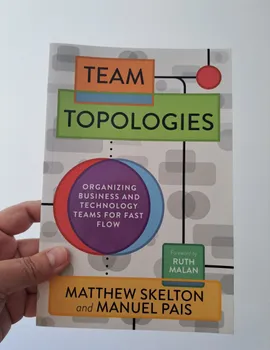
Team Topologies is one of the most influential modern books on organizational design for software delivery. It’s directly aligned with Agile, DevOps, enterprise transformation, and fast‑flow architectures.
Core takeaway
Section titled “Core takeaway”Team structure is the primary driver of delivery speed.
Skelton and Pais argue that you must design teams as deliberately as you design software architecture. When team boundaries, responsibilities, and interactions are intentional, organizations achieve fast flow of value, reduced cognitive load, and more resilient systems.
Key concepts
Section titled “Key concepts”1. Four fundamental team types
Section titled “1. Four fundamental team types”The book defines a simple but powerful taxonomy:
- Stream‑aligned teams — aligned to a flow of work; own delivery end‑to‑end.
- Enabling teams — help stream‑aligned teams adopt new capabilities; temporary and advisory.
- Complicated‑subsystem teams — handle specialized areas requiring deep expertise.
- Platform teams — provide internal services/tools as a product for other teams.
This clarity prevents overlapping responsibilities and reduces handoffs.
2. Three interaction modes
Section titled “2. Three interaction modes”To avoid endless collaboration and confusion, the authors define explicit modes:
- Collaboration — short‑term, high‑bandwidth joint work for discovery.
- X‑as‑a‑Service — one team provides a stable service to others.
- Facilitating — one team helps another learn or improve.
Clear modes prevent friction and make expectations explicit.
3. Cognitive load as a design principle
Section titled “3. Cognitive load as a design principle”A major innovation of the book: team boundaries should be shaped by cognitive load, not org charts.
Types of cognitive load: intrinsic, extraneous, and germane.
Teams overloaded with domain complexity or tooling responsibilities slow down delivery.
4. Fast flow as the north star
Section titled “4. Fast flow as the north star”The authors emphasize that the goal is fast, safe, sustainable flow of value.
This requires:
- minimizing handoffs
- reducing dependencies
- aligning teams to value streams
- evolving team structures as systems mature
5. Adaptive, ecosystem‑based organizational design
Section titled “5. Adaptive, ecosystem‑based organizational design”Team Topologies rejects static hierarchies.
Organizations should behave like flourishing ecosystems, evolving team boundaries and interactions as technology and strategy change.
The 2025 second edition reinforces this with new case studies across industries (pharma, law, HR, healthcare).
Why it matters
Section titled “Why it matters”Team Topologies has become foundational in modern engineering organizations because it provides a practical, operational model for structuring teams in cloud‑native, DevOps, and AI‑accelerated environments.
It aligns perfectly with Agile scaling, DevOps, organizational design, and fast‑flow architectures.