Agile IT Organization Design
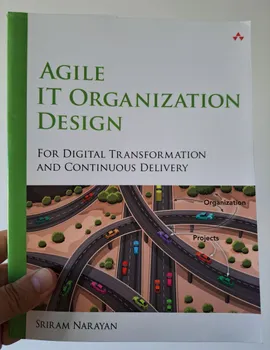
Agile IT Organization Design: For Digital Transformation and Continuous Delivery by Sriram Narayan is a well‑known book in the Agile/DevOps/digital‑transformation space. It was published by Addison‑Wesley in 2015 and is widely referenced in ThoughtWorks circles and enterprise‑agility discussions.
What the book is about
Section titled “What the book is about”1. Business–IT Effectiveness
Section titled “1. Business–IT Effectiveness”Narayan frames digital transformation as a shift from siloed IT to business‑aligned, outcome‑driven IT. He critiques the traditional business–IT divide and introduces the idea of outcome owners and value‑stream alignment.
- Business‑IT alignment
- Outcome‑driven design
2. The Agile Credo
Section titled “2. The Agile Credo”He revisits the Agile Manifesto, continuous delivery, DevOps, and Agile culture — emphasizing value over predictability, responsiveness over cost‑efficiency, and intrinsic motivation (autonomy, mastery, purpose).
- Agile culture
- Continuous delivery
3. Team Design
Section titled “3. Team Design”One of the strongest parts of the book:
- Why activity‑oriented teams (QA teams, architecture teams, ops teams) create high‑latency handoffs
- How to move toward cross‑functional, outcome‑oriented teams
- DevOps as a cross‑functional team, not a tooling initiative
- When shared services make sense — and when they destroy flow
- Cross‑functional teams
- DevOps team topology
4. Accountability & Alignment
Section titled “4. Accountability & Alignment”Narayan explains how power structures, hierarchy, and unclear accountability undermine agility. He proposes:
- Clear decision accountability
- Outcome owners
- Reducing power struggles
- Aligning IT with business strategy
- Decision accountability
- IT alignment models
5. Finance, Metrics, and Organizational Norms
Section titled “5. Finance, Metrics, and Organizational Norms”He critiques project‑based funding, cost‑efficiency thinking, and harmful metrics. Instead, he advocates:
- Funding capabilities rather than projects
- Metrics that promote agility rather than prevent it
- Cultural evolution through structural change
- Agile finance
- Agile metrics
Core takeaway
Section titled “Core takeaway”The book argues that IT agility is an organizational design problem, not just a software‑delivery problem. Narayan shows how structures, accountability, team topology, finance, culture, and metrics must evolve to support continuous delivery, DevOps, and digital transformation at scale.
Why it matters
Section titled “Why it matters”Among Agile/digital‑transformation books, Narayan’s stands out because it is deeply practical and grounded in real enterprise experience (15+ years at ThoughtWorks). It bridges:
- Agile
- DevOps
- Organizational design
- Digital transformation
- Team topology
It’s especially relevant if you’re working on LLM platforms, API ecosystems, or cross‑functional product teams, because it explains how to structure IT so that teams can deliver continuously and autonomously.