DevSecOps
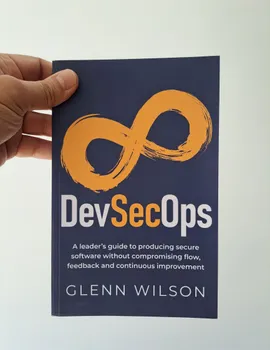
DevSecOps: A Leader’s Guide to Producing Secure Software Without Compromising Flow, Feedback and Continuous Improvement by Glenn Wilson. The book’s central premise is that security should be integrated into the software delivery process without slowing down the speed and effectiveness of DevOps. Rather than treating security as a gate at the end of development, Wilson argues that security must become a shared responsibility embedded throughout the value stream.
What the book is about
Section titled “What the book is about”At a high level, the book is a practical leadership guide for introducing security into modern software delivery environments.
Wilson discusses how organisations can:
1. Build a Security Culture
Section titled “1. Build a Security Culture”One of the book’s strongest themes is culture.
Many organisations view security teams as auditors or gatekeepers. Wilson argues that this creates friction and slows delivery. Instead, security should become a collaborative partner that helps engineering teams deliver secure solutions.
Key ideas include:
- Shared ownership of security
- Security champions within teams
- Leadership support for secure practices
- Security awareness and education
2. Integrate Security into DevOps
Section titled “2. Integrate Security into DevOps”The book explains how security activities can be incorporated into each stage of the software lifecycle.
Examples include:
- Threat modelling
- Secure coding practices
- Dependency management
- Infrastructure as Code security
- Container security
- Continuous compliance
The goal is to move security controls closer to where software is designed and built rather than relying solely on late-stage reviews.
3. Automate Security Testing
Section titled “3. Automate Security Testing”Wilson strongly advocates automation.
Security checks should run alongside:
- Build pipelines
- Unit tests
- Integration tests
- Deployment workflows
Automated approaches reduce human bottlenecks and allow teams to detect vulnerabilities earlier and more cheaply. The book specifically highlights automating integrated security testing within delivery pipelines.
4. Create Feedback Loops
Section titled “4. Create Feedback Loops”Borrowing heavily from DevOps principles, the book stresses that feedback is essential for improvement.
Security information should be:
- Fast
- Actionable
- Visible to developers
Examples include:
- Security dashboards
- Vulnerability metrics
- Pipeline alerts
- Incident post-mortems
The objective is learning rather than blame.
5. Measure Security as Part of the Value Stream
Section titled “5. Measure Security as Part of the Value Stream”Wilson encourages leaders to treat security as a measurable capability.
Instead of relying only on compliance audits, organisations should measure:
- Vulnerability trends
- Remediation speed
- Security testing coverage
- Security defect escape rates
Security becomes part of operational excellence rather than a separate discipline. The book explicitly discusses measuring security within value streams.
Core takeaway
Section titled “Core takeaway”The single most important takeaway is:
Security and delivery speed are not opposing goals. Organisations can achieve both by integrating security into culture, processes, automation, feedback loops, and continuous improvement practices.
Wilson presents DevSecOps not as a collection of security tools, but as an organisational transformation. Security becomes everyone’s responsibility, from developers and operations teams to leadership. The emphasis is on:
- Building a security-first culture
- Shifting security activities left into the development lifecycle
- Automating security testing
- Creating rapid feedback loops
- Continuously measuring and improving security outcomes
The book repeatedly reinforces that security must support the goals of DevOps rather than work against them.
Why it matters
Section titled “Why it matters”For Leaders
Section titled “For Leaders”Many security books target engineers. Wilson’s book is different because it focuses heavily on leadership and organisational change.
Leaders often face a perceived trade-off:
- Faster delivery
- Better security
The book argues that mature DevSecOps practices remove that trade-off.
This message is particularly relevant for:
- CTOs
- Engineering Directors
- Software Development Managers
- Security Leaders
- Agile Transformation Leaders
For DevOps Teams
Section titled “For DevOps Teams”Traditional security processes often create bottlenecks:
- Security reviews at release time
- Manual audits
- Separate security departments
These approaches do not scale in environments using continuous delivery.
The book provides a framework for integrating security into daily engineering work rather than treating it as a separate phase.
For Modern Organisations
Section titled “For Modern Organisations”Today’s software depends on:
- Cloud platforms
- APIs
- Containers
- Open-source libraries
- Continuous deployment pipelines
The attack surface is much larger than in traditional software environments.
Wilson’s argument is that organisations cannot secure these environments using traditional governance alone. Security must be automated, embedded, and continuously improved.
In summary:
Its greatest value is not deep technical security content. Instead, it explains how leaders can create an organisation where security, delivery speed, quality, and continuous improvement reinforce each other instead of competing.
The book shows how to transform security from a delivery bottleneck into an integrated capability that strengthens DevOps performance and software quality.