Zone to Win
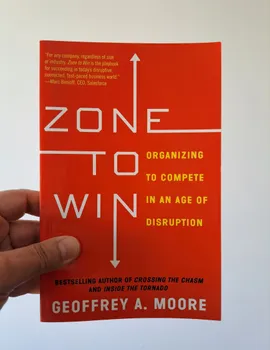
Zone to Win: Organizing to Compete in an Age of Disruption by Geoffrey A. Moore is one of the most influential strategy books for established companies trying to innovate without damaging their core business. It is often considered a practical follow-up to Moore’s earlier classic, Crossing the Chasm.
What the book is about
Section titled “What the book is about”The book addresses a problem that affects almost every successful company:
How do you pursue disruptive innovation while continuing to hit your current business targets?
Established businesses are excellent at:
- Predictability
- Efficiency
- Forecasting
- Process management
But disruptive opportunities start as:
- Small markets
- Uncertain demand
- Low revenue
- High risk
The same managers who are rewarded for operational excellence often end up unintentionally killing innovation because the early numbers don’t look attractive compared to the core business.
Moore argues that companies must deliberately separate:
- Sustaining innovation from disruptive innovation
- Core-business governance from startup-style governance
- Current revenue priorities from future growth priorities
The book uses examples including Microsoft and Salesforce to illustrate how large enterprises can organise themselves to pursue the next wave of growth while maintaining current success.
Core takeaway
Section titled “Core takeaway”The central idea is simple:
The operating model required to run a successful existing business is fundamentally different from the operating model required to create a disruptive new business.
Most organisations fail at innovation because they try to manage both with the same processes, metrics, budgeting, leadership expectations, and governance. As a result, the core business overwhelms the innovation effort.
Moore’s solution is to organise the company into four distinct zones, each with a different mission, funding model, leadership style, and success criteria.
The Four Zones
Section titled “The Four Zones”1. Performance Zone
Section titled “1. Performance Zone”The business that generates today’s revenue.
Focus:
- Sales
- Customers
- Market share
- Financial results
- Quarterly performance
Key question:
How do we win in our current market?
2. Productivity Zone
Section titled “2. Productivity Zone”The supporting functions that make the company efficient.
Focus:
- Finance
- HR
- IT
- Operations
- Shared services
- Process optimisation
Key question:
How do we operate more efficiently?
3. Incubation Zone
Section titled “3. Incubation Zone”The home of future opportunities.
Focus:
- Emerging products
- Innovation
- Experiments
- New business models
The goal is not revenue.
The goal is:
Find product-market fit and prove the opportunity is real.
4. Transformation Zone
Section titled “4. Transformation Zone”The bridge between innovation and scale.
This is arguably the most important concept in the book.
Once an innovation proves itself, it must be protected and prioritised so it can become a major business.
Focus:
- Scaling disruptive opportunities
- Redirecting resources
- Organisational change
- Strategic transformation
Key question:
Which innovation is important enough to become the company’s next growth engine?
Why it matters
Section titled “Why it matters”1. Most Companies Die From Success
Section titled “1. Most Companies Die From Success”A company becomes good at what made it successful.
That creates:
- Organisational inertia
- Risk aversion
- Attachment to existing revenue streams
The book explains why market leaders often miss the next wave of disruption, even when they see it coming.
Examples throughout history include:
- Nokia
- BlackBerry
- Sun Microsystems
- Digital Equipment Corporation
They were not necessarily unaware of change; they were unable to reorganise around it.
2. Innovation Is Primarily an Organisational Problem
Section titled “2. Innovation Is Primarily an Organisational Problem”Many leaders assume innovation fails because:
- The technology was weak
- The product was poor
- The market wasn’t ready
Moore argues that the bigger problem is often organisational design.
The innovation team is measured by the same KPIs as the mature business, which virtually guarantees failure.
3. It Provides a Practical Governance Model
Section titled “3. It Provides a Practical Governance Model”Unlike books that simply say “be more innovative,” Zone to Win explains:
- How to allocate executive attention
- How to fund innovation
- How to prioritise initiatives
- When to scale a new business
- How to avoid competing priorities
This makes it useful for executives, product leaders, portfolio managers, and transformation leaders.
4. Highly Relevant for Modern Digital Transformation
Section titled “4. Highly Relevant for Modern Digital Transformation”Today, organisations face disruption from:
- AI
- Automation
- Cloud platforms
- Digital ecosystems
- New business models
A common mistake is trying to run AI initiatives as side projects while expecting existing teams to maintain the same delivery commitments.
Moore’s framework suggests:
- Incubate promising AI initiatives separately.
- Select only a few transformation bets.
- Give those bets executive sponsorship.
- Scale them deliberately through the Transformation Zone.
This insight is especially relevant for companies currently trying to become AI-enabled enterprises.
In summary:
Zone to Win teaches that established organisations must separate today’s business from tomorrow’s business through distinct operating zones, otherwise the demands of the present will suffocate the opportunities of the future.