The DevOps Adoption Playbook
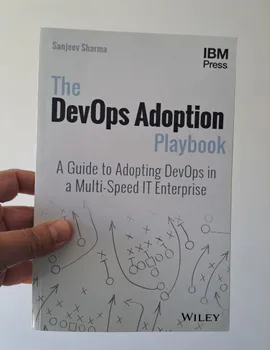
The DevOps Adoption Playbook by Sanjeev Sharma is a well‑known, enterprise‑focused guide on how to adopt DevOps in large, multi‑speed IT organizations. It’s one of the few books that explicitly addresses the realities of legacy systems, complex governance, regulated environments, and organizational inertia, rather than assuming a startup‑like greenfield context.
What the book is about
Section titled “What the book is about”1. DevOps foundations
Section titled “1. DevOps foundations”- DevOps as a cultural and professional movement, not a toolset.
- Emphasis on collaboration, automation, continuous improvement, and rapid, iterative delivery.
- The goal: deliver high‑quality software faster while improving customer outcomes.
2. DevOps adoption journey
Section titled “2. DevOps adoption journey”- DevOps is a long-term transformation, not a quick rollout.
- Early stages focus on trust, shared responsibility, and automation of routine tasks (testing, deployment, monitoring).
- Later stages deal with enterprise constraints: legacy systems, compliance, multi-speed IT.
3. Business case development
Section titled “3. Business case development”- Uses the Business Model Canvas to justify DevOps transformation.
- Helps leaders articulate value propositions, cost structures, and key activities.
4. DevOps plays for optimizing delivery
Section titled “4. DevOps plays for optimizing delivery”- Treats DevOps as an optimization exercise across the delivery pipeline.
- Plays include automation, pipeline standardization, microservices, API economy, and platform engineering.
5. DevOps plays for innovation
Section titled “5. DevOps plays for innovation”- Shows how DevOps enables rapid experimentation and innovation at scale.
- Includes plays for building DevOps platforms, microservices architectures, and innovation‑oriented team structures.
6. Scaling DevOps in the enterprise
Section titled “6. Scaling DevOps in the enterprise”- DevOps Center of Competency
- Culture of innovation and continuous improvement
- Standardization of tools and processes
- Security considerations (“DevSecOps before DevSecOps was a buzzword”)
- Team models for large organizations
7. Leading DevOps adoption
Section titled “7. Leading DevOps adoption”- DevOps as a transformation exercise, not a project.
- Importance of collaboration, trust, and pilot projects.
- “Rearing unicorns on an aircraft carrier” — enabling high‑performance teams inside legacy enterprises.
Core takeaway
Section titled “Core takeaway”The book argues that DevOps at enterprise scale is fundamentally a transformation of people, processes, and automation, not a tooling exercise. It provides a structured “playbook” of actionable plays for optimizing delivery pipelines, driving innovation, scaling DevOps, and leading cultural change.
Why it matters
Section titled “Why it matters”- Awarded DevOps Book of the Year (2017).
- Written by IBM’s Global CTO for DevOps Adoption, bringing deep enterprise experience.
- One of the most practical and realistic DevOps books for large organizations.