The Medici Effect
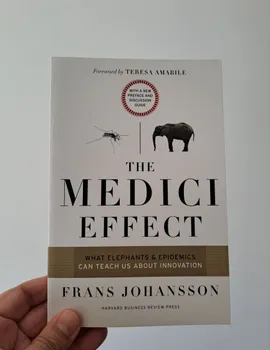
The Medici Effect is one of the most influential books on innovation and creativity. In it, Frans Johansson argues that breakthrough innovation is most likely to happen at the intersection of different disciplines, industries, cultures, and ways of thinking, an idea he calls the “Medici Effect”.
What the book is about
Section titled “What the book is about”The book explores how innovations arise when different fields collide.
Johansson calls these collision points**“The Intersection.”** Examples include:
- Using biological concepts to solve engineering problems.
- Applying psychological insights to software design.
- Combining art and technology to create new products.
- Bringing together people from different cultures and industries to solve complex challenges.
The book is structured around three major ideas:
1. Innovation Happens at Intersections
Section titled “1. Innovation Happens at Intersections”Many transformative ideas are combinations of existing ideas from different domains.
Examples in the book include:
- A chef combining unexpected ingredients and techniques.
- Scientists borrowing ideas from unrelated disciplines.
- Darwin contributing insights that challenged established thinking despite not being an expert in every relevant field.
2. Break Down Mental Barriers
Section titled “2. Break Down Mental Barriers”Experts often become trapped by the assumptions of their field.
Johansson argues that:
- Expertise is valuable.
- But expertise can also create blind spots.
- Exposure to different domains helps reveal new possibilities.
3. Generate More Ideas
Section titled “3. Generate More Ideas”The book rejects the belief that innovation comes from a single genius moment.
Instead:
- Produce many ideas.
- Experiment frequently.
- Accept failure as part of the innovation process.
- Increase the probability of success through volume and diversity of thinking.
Core takeaway
Section titled “Core takeaway”The central message is:
The most valuable innovations often come not from going deeper into a single specialty, but from combining ideas from multiple unrelated fields.
Johansson suggests that innovation emerges when people bring together concepts that normally do not interact. Just as the Medici family helped create the Renaissance by bringing artists, scientists, architects, philosophers, and thinkers together in Florence, modern innovators can create breakthroughs by connecting diverse perspectives.
In practical terms:
- Innovation is often a cross-pollination problem, not an expertise problem.
- The more diverse your experiences, knowledge, and network, the more likely you are to discover unique ideas.
- Breakthroughs frequently come from outsiders who can see possibilities that experts overlook.
- Diversity of thought is a competitive advantage, not just a social objective.
Why it matters
Section titled “Why it matters”1. Modern Problems Are Interdisciplinary
Section titled “1. Modern Problems Are Interdisciplinary”Today’s biggest challenges rarely fit into a single field:
- AI combines computer science, psychology, linguistics, design, and ethics.
- Healthcare combines medicine, data science, engineering, and behavioural science.
- Digital transformation requires business, technology, leadership, and organisational change.
The book’s ideas are arguably even more relevant today than when it was published.
2. It Challenges Traditional Career Advice
Section titled “2. It Challenges Traditional Career Advice”Traditional advice often says:
Pick one thing and become the best at it.
Johansson counters with:
Become excellent in one area, but deliberately explore many others.
People who bridge domains often create more original solutions because they can transfer knowledge across boundaries.
3. It Explains Why Diverse Teams Outperform Homogeneous Ones
Section titled “3. It Explains Why Diverse Teams Outperform Homogeneous Ones”Teams of people with similar backgrounds tend to think similarly.
Teams with varied:
- cultures,
- experiences,
- educational backgrounds,
- industries,
are more likely to create unexpected insights and innovative solutions.
In summary:
The Medici Effect teaches that breakthrough innovation is most likely to occur when you intentionally combine ideas, people, and experiences from radically different domains rather than staying within the boundaries of a single specialty.