Accelerate
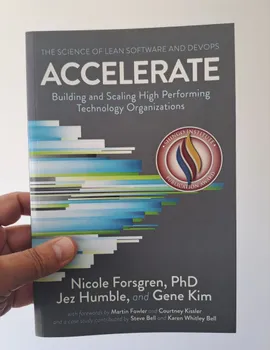
Accelerate: The Science of Lean Software and DevOps by Nicole Forsgren, Jez Humble, and Gene Kim is one of the most important books ever published in modern software engineering, DevOps, and Lean product delivery. It was released in 2018 and is grounded in four years of rigorous academic research across 23,000+ professionals and 2,000+ organizations worldwide.
What the book is about
Section titled “What the book is about”The book distills the findings of the State of DevOps Reports into a set of causal (not just correlational) relationships between engineering practices and business outcomes. Key themes include:
- DORA metrics — deployment frequency, lead time for changes, mean time to restore service, change failure rate. These measure delivery performance.
- Continuous Delivery — trunk-based development, test automation, CI, small batches.
- Loosely coupled architecture — enabling teams to deliver independently.
- Lean management — visualizing work, limiting WIP, reducing batch size.
- Generative culture — trust, psychological safety, fast information flow.
- Transformational leadership — behaviors that make change stick.
Core takeaway
Section titled “Core takeaway”High-performing technology organizations achieve both speed and stability — and the practices that enable this are measurable, repeatable, and scientifically validated.
Why it matters
Section titled “Why it matters”Accelerate is unique because it uses structural equation modeling and psychometrics to prove causality. It shows that:
- Speed and stability are not in conflict — elite performers excel at both.
- Software delivery performance predicts organizational performance — profitability, productivity, market share.
- Culture is a stronger predictor of performance than tools or process.
- Change Approval Boards (CABs) harm both speed and stability.
The famous numbers (2017 data)
Section titled “The famous numbers (2017 data)”Elite performers:
- 46× more frequent deployments
- 440× faster lead time
- 170× faster MTTR
- 5× lower change failure rate
These numbers are the foundation of what is now called the DORA framework, used globally by engineering teams.