Authentic Conversations
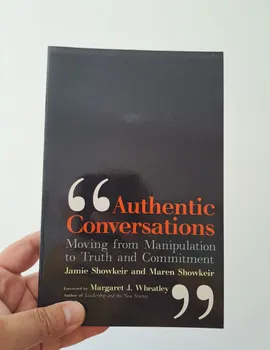
Authentic Conversations by Jamie Showkeir and Maren Showkeir is a well‑known book in the organizational‑culture and leadership space.
What the book is about
Section titled “What the book is about”1. Conversations create culture
Section titled “1. Conversations create culture”The Showkeirs argue that everyday conversations reveal, sustain, or change organizational culture.
Traditional conversations often:
- Sugarcoat reality
- Hide facts
- Create dependency
- Encourage helplessness
These patterns reinforce a parent–child culture, where leaders “caretake” and employees “comply.”
2. The shift: Parent–child → Adult–adult
Section titled “2. The shift: Parent–child → Adult–adult”The book shows how to move toward adult–adult relationships, where people:
- Tell the truth without manipulation
- Take responsibility for their commitments
- Engage in partnership rather than control
- Contribute their knowledge and experience
This shift is essential for accountability, engagement, and business results.
3. The cost of manipulative conversations
Section titled “3. The cost of manipulative conversations”Manipulative conversations lead to:
- Cynicism
- Disengagement
- Eroded trust
- Poor performance
The authors illustrate these dynamics with examples from 25+ years of consulting work.
4. Tools and models you can use immediately
Section titled “4. Tools and models you can use immediately”The book includes:
- Sample scripts for difficult conversations
- Examples of parent–child vs. adult–adult dialogue
- Guidance on intentions, language, and confronting issues
- A practical guide for transforming conversations in your team or organization
These tools make the book highly actionable.
Core takeaway
Section titled “Core takeaway”Its core argument is simple and powerful: if you want to change your culture, you must change your conversations.
Authentic Conversations teaches leaders and teams how to replace manipulative, parent–child workplace dynamics with adult–adult, truth‑based, accountability‑driven conversations. These conversations create engagement, commitment, and real performance improvements.
Why it matters
Section titled “Why it matters”This book sits in the same conceptual family as Agile Conversations, Fierce Conversations, and Difficult Conversations.
Where Agile Conversations leans on Action Science and conversational patterns, Authentic Conversations focuses more on organizational culture, adult development, and accountability.