That's Not How We Do It Here!
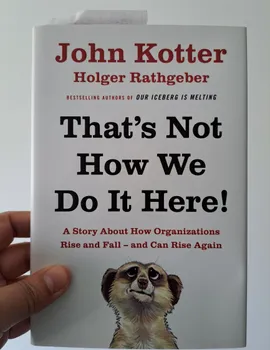
That’s Not How We Do It Here! by John P. Kotter and Holger Rathgeber is a short, story‑driven book that uses a meerkat fable to explain why organizations rise, fall, and can rise again. It’s essentially Kotter’s change‑leadership theory wrapped in a narrative designed to make the concepts intuitive and memorable.
What the book is about
Section titled “What the book is about”- A meerkat clan in crisis — A drought and predator attacks destabilize a once‑stable clan. Their rigid hierarchy and “that’s not how we do it here” mindset prevent adaptation.
- Management vs. leadership — Kotter shows that management brings reliability and structure, but without leadership, organizations become brittle and slow. Leadership brings innovation and adaptability, but without management, chaos emerges. The book advocates a dual operating system combining both.
- Why organizations fall — Complacency, rigid roles, slow decision cycles, and resistance to change.
- How they rise again — Empowering frontline ideas, fostering urgency, encouraging experimentation, and aligning people around a compelling purpose.
Key ideas
Section titled “Key ideas”- Servant leadership — Leaders remove obstacles and enable teams.
- Decision‑making under uncertainty — Clear principles + rapid iteration.
- Psychological safety — Teams innovate when they feel safe to speak up.
- Delegation as empowerment — Delegating authority, not just tasks.
- Leading through change — Communicate the “why,” involve people, maintain stability.
Core takeaway
Section titled “Core takeaway”The book argues that organizations fail when they rely too heavily on rigid management systems or too heavily on free‑form leadership. Sustainable success requires both: disciplined management and adaptive, purpose‑driven leadership.
Why it matters
Section titled “Why it matters”- It’s a practical companion to Kotter’s broader change‑leadership work (including Leading Change).
- The fable format makes complex organizational dynamics easy to grasp.
- It provides a clear model for balancing structure and innovation — highly relevant for Agile, Lean, and modern digital‑transformation environments.